
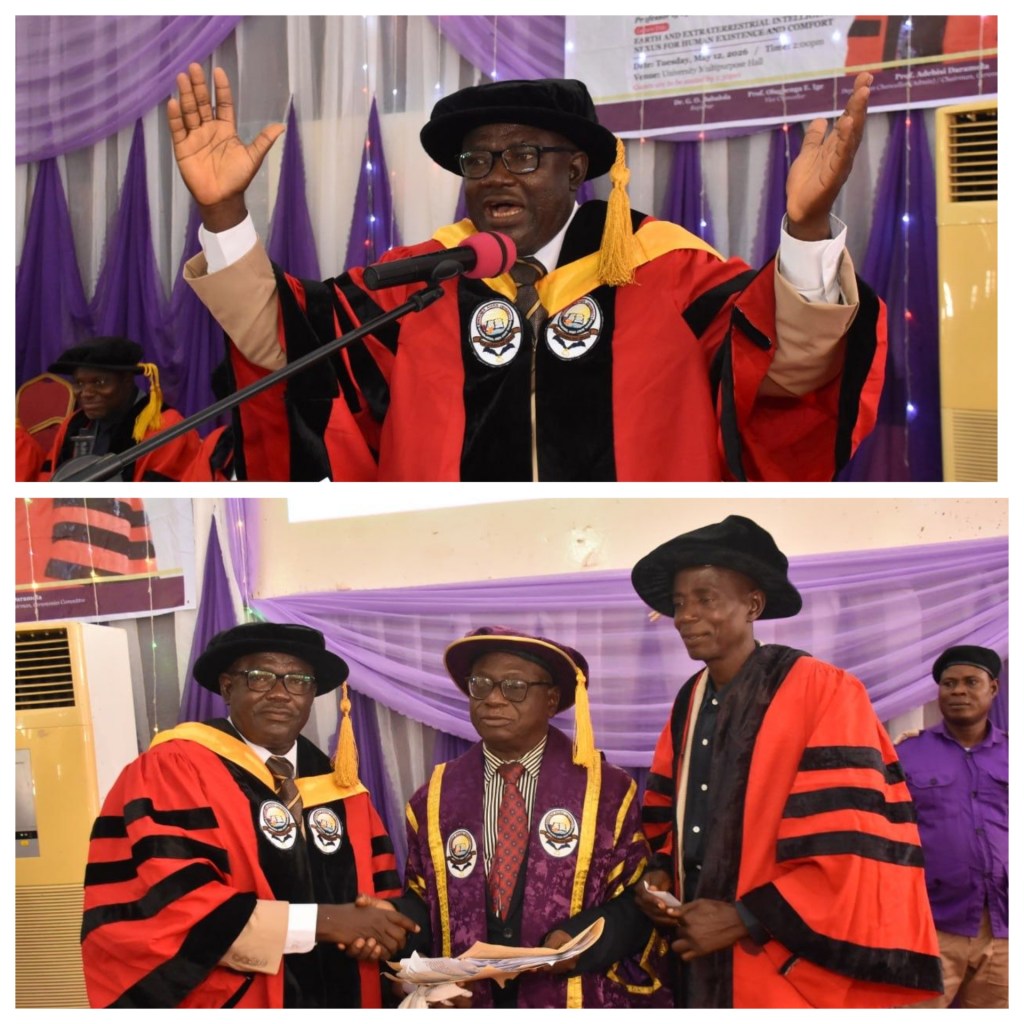
..calls for increased funding for indigenous space tech at AAUA inaugural lecture
Professor of Space Physics, Sola Fayose, has appealed for increased investment in space research to promote the development of locally made space technologies and applications, saying it would position Nigeria as a global player in the production of space products and services, rather than merely a consumer.
He stated that space research could drive technological advancement, create job opportunities, improve space literacy, aid military or security-related activities, foster international collaboration, and support medical and biological research. According to him, it could also open new career paths for young people, ultimately contributing to economic development and an improved standard of living.
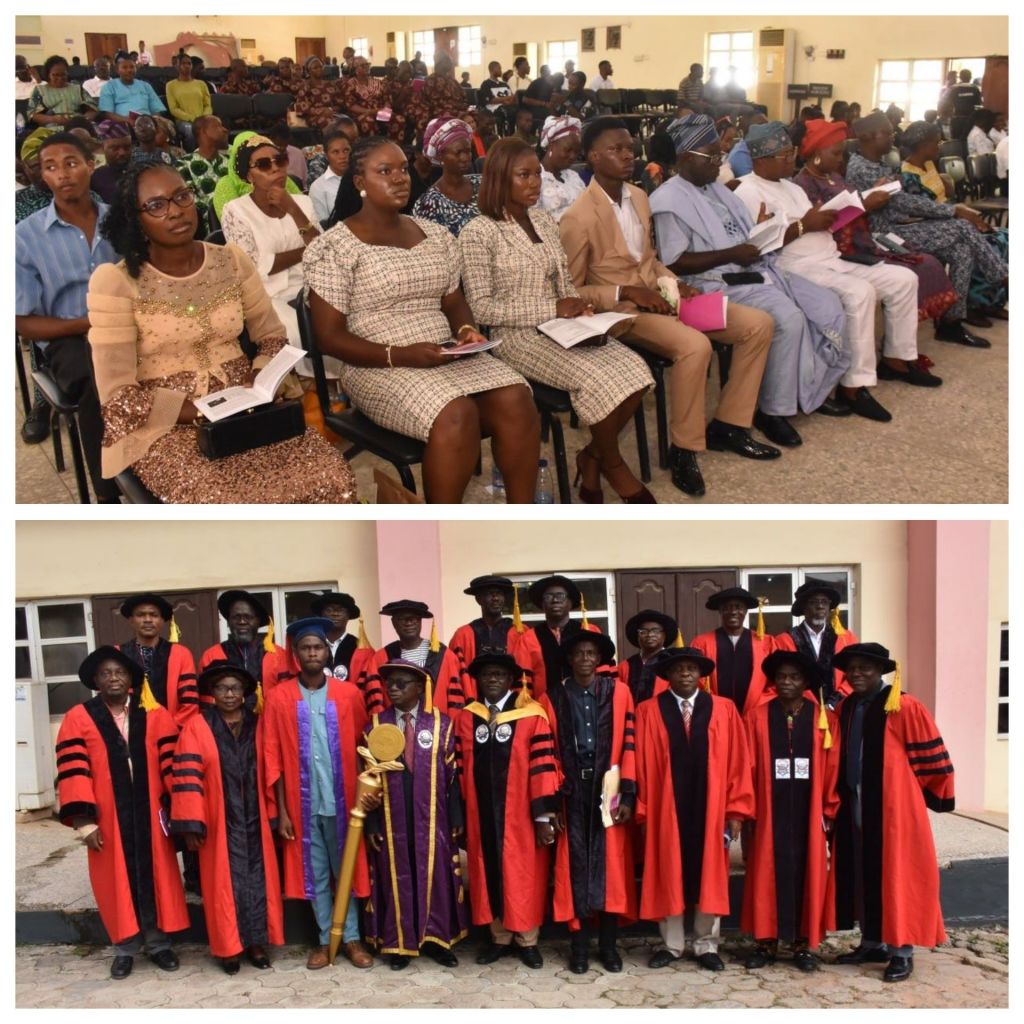
Prof. Fayose revealed these findings on Tuesday, May 12, 2026, while delivering the 62nd inaugural lecture of Adekunle Ajasin University, Akungba Akoko, Ondo State. The lecture was titled “Earth and Extraterrestrial Intelligence: Nexus for Human Existence and Comfort”.
While explaining the link between human existence and extraterrestrial intelligence, he described the latter as anything existing or originating beyond Earth, including life forms, cosmic signals, space environments, the upper atmosphere, and other galaxies in the universe.
He noted that space physics is a field that examines the relationship between Earth and the wider universe in order to understand its influence on human existence and comfort within the cosmos.
Stressing the relevance of studies on space-related matters, the space physicist cited the Sun as the primary source of electromagnetic energy powering the atmosphere and oceanic circulation. He explained that the Sun emits electromagnetic radiation, with its visible light converted by plants into food through photosynthesis, making the food chain dependent on plants.
A major supporter of the life cycle, he further noted that the Sun furnishes, directly or indirectly, all the energy supporting life on Earth, except for that derived from deep-sea hydrothermal vents. He explained that most foods and fuels are ultimately derived from plants, which use the energy of sunlight to sustain life on Earth.
Prof. Fayose added that the scientific study of the space environment has facilitated the invention of space-based technologies such as GSM technology, credit and ATM transactions, online and mobile banking, GNSS navigation, internet services, satellite television and cable, air, sea and land transportation, and modern military systems. All of these have significantly improved human existence and comfort on Earth and advanced human understanding of the Earth-space system.
He noted that these technologies also support sustainable development in agriculture, health, education, transportation, and digital communication. According to him, this accentuates the critical need for more intensive space research to further enhance socio-economic development and improve the quality of human life.
Hence, the don recommended that the government adequately fund existing space centres, such as Centres for Space Research and Applications, to empower them to contribute to the national development needs of space science and technology. He also called for the establishment of human capital development programmes to attract young students into a postgraduate channel that serves the needs of an indigenous space sector and other high-end skills demands in the evolving socio-economic landscape.
“The acquisition of state-of-the-art facilities to support advanced deep-space teaching and research, and improving downstream applications for enhanced development, must be encouraged,” he said. “The provision of electricity is a necessity for meaningful research. The government should treat this with all the seriousness it deserves. Adequate power supply should be provided in academic and research institutions to promote research.”
Prof. Fayose also urged the government to place more priority on patronising locally developed research equipment, while making the procurement of such equipment tax-free. He added that appropriate legislation must be formulated to mandate industries to support the scientific research of universities in their operational areas.
He proposed a collaboration between government agencies such as the National Space Research and Development Agency (NASRDA) and universities or research institutes to address the lack of data by making data available for academic and research purposes.
Furthermore, the inaugural lecturer advocated for the establishment of Space Physics as an undergraduate course in universities across the country, suggesting that the course should be taught in indigenous languages.
“As it has been done in some advanced countries such as China, Japan, Singapore, and Germany, teaching science in students’ mother tongue can enhance the learning of much-dreaded science subjects like Physics, Chemistry, Computer Science, and Mathematics,” he explained.
He concluded by encouraging international collaboration among researchers from diverse backgrounds and countries to amass resources, expertise, and perspectives in order to solve some of the universe’s most “pressing mysteries”. He remarked that this collaboration can also foster global citizenship and cooperation, thereby demonstrating the power of science to transcend borders.
Earlier, while presenting the inaugural lecturer, the Vice Chancellor and Chairman of the Occasion, Prof. Olugbenga Ige, described the academic gathering as a cherished tradition that connects rigorous research with the public celebration of new knowledge. Prof. Ige, who was represented by the Deputy Vice-Chancellor (Administration), Prof. Adebisi Daramola, congratulated the inaugural lecturer on attaining a major milestone in his academic career as a space physics scholar and a mentor to younger generations.
 ..all about information services
Leave a Reply