
By Mary Agidi
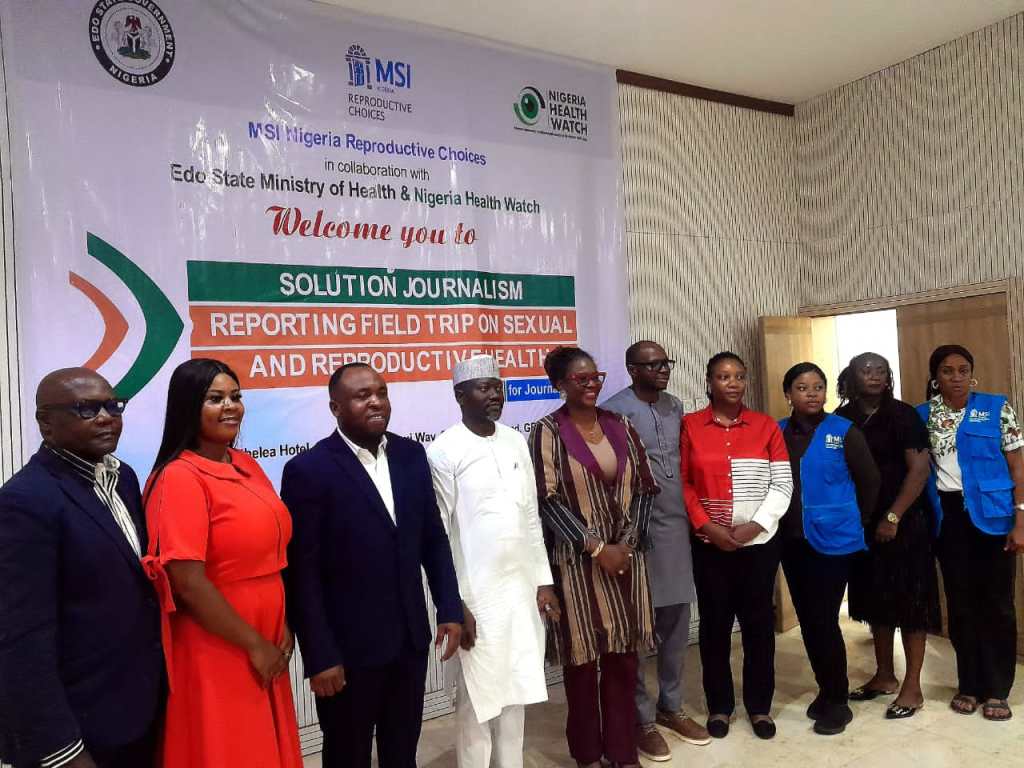
MSI Nigeria, in collaboration with Nigeria Health Watch, has organised a training on Solutions Journalism Reporting for journalists across Southern Nigeria to strengthen evidence-based reporting, improve public trust, and promote stories that highlight practical responses to societal challenges, particularly in the health sector.
The training, held in Benin City, brought together media professionals to build their capacity in reporting beyond problems by investigating and documenting effective solutions that can be replicated.
Declaring the training open, the Edo State Commissioner for Health, Dr. Cyril Adams-Oshiomhole, urged journalists to embrace solutions journalism as a tool for improving health outcomes and strengthening accountability.
He said journalism should not stop at exposing problems but should also examine what is working and why.
“Journalism has always been regarded as the fourth estate of the realm. It informs, educates, holds leaders accountable, and gives a voice to the voiceless. However, journalism should not only expose problems; it should also illuminate solutions,” he said.
According to the commissioner, responsible journalism has consistently contributed to better public health outcomes, noting that accurate reporting during disease outbreaks saves lives, factual coverage of immunisation campaigns increases vaccine acceptance, while balanced reporting during health emergencies reduces panic and encourages appropriate public response.
He stressed that Nigeria’s healthcare sector is filled with stories of innovation and resilience that deserve evidence-based reporting.
“Across Nigeria, health workers continue to deliver quality care under challenging circumstances, communities are finding creative ways to improve maternal and child health, and young innovators are leveraging technology to bridge healthcare gaps. These stories deserve evidence-based reporting that highlights what works, what does not, and what lessons can be replicated,” he added.
Adams-Oshiomhole explained that solutions journalism is not public relations or positive publicity but a rigorous, balanced, and accountable form of reporting that critically evaluates responses to societal problems.
He also advocated stronger collaboration among journalists, health institutions, researchers, civil society organisations, and communities to improve public understanding and accountability.
The commissioner commended MSI Nigeria and Nigeria Health Watch for investing in journalists’ capacity, noting that improving healthcare extends beyond hospitals and medicines to strengthening communication, public trust, and informed decision-making.
Earlier, the Regional Manager for the South-South and South-West at MSI Nigeria Reproductive Choices, Mrs. Omeche, highlighted the need to deepen conversations around Sexual and Reproductive Health and Rights (SRHR) and family planning in Nigeria.
She disclosed that Nigeria’s modern contraceptive prevalence rate (mCPR) stands at 18 per cent, while outlining MSI Nigeria’s interventions to ensure women can decide freely and responsibly when to have children.
Also speaking, Senior Editor at Nigeria Health Watch, Mrs. Olubunmi Oyebanji, who delivered a presentation titled “Solutions Journalism Demystified,” described solutions journalism as a rigorous, evidence-based and data-driven approach to reporting on responses to societal problems.
She explained that the approach differs from advocacy, public relations, or praise-singing because it critically examines whether proposed solutions are effective and identifies lessons that can be replicated elsewhere.
Participants were also trained on mobile journalism, media ethics, empathy in reporting, and the importance of obtaining informed consent when reporting sensitive stories.


Leave a Reply