

In this piece, MARY AGIDI examines the sad, lonely life which is mostly the lot of elderly people in this clime, owing to neglect usually by uncaring children and relations, and failure to plan ahead for old age.
In all, this feature x-rays how citizens die alone, unprotected; and the deadly cost of Nigeria’s geriatric gap.
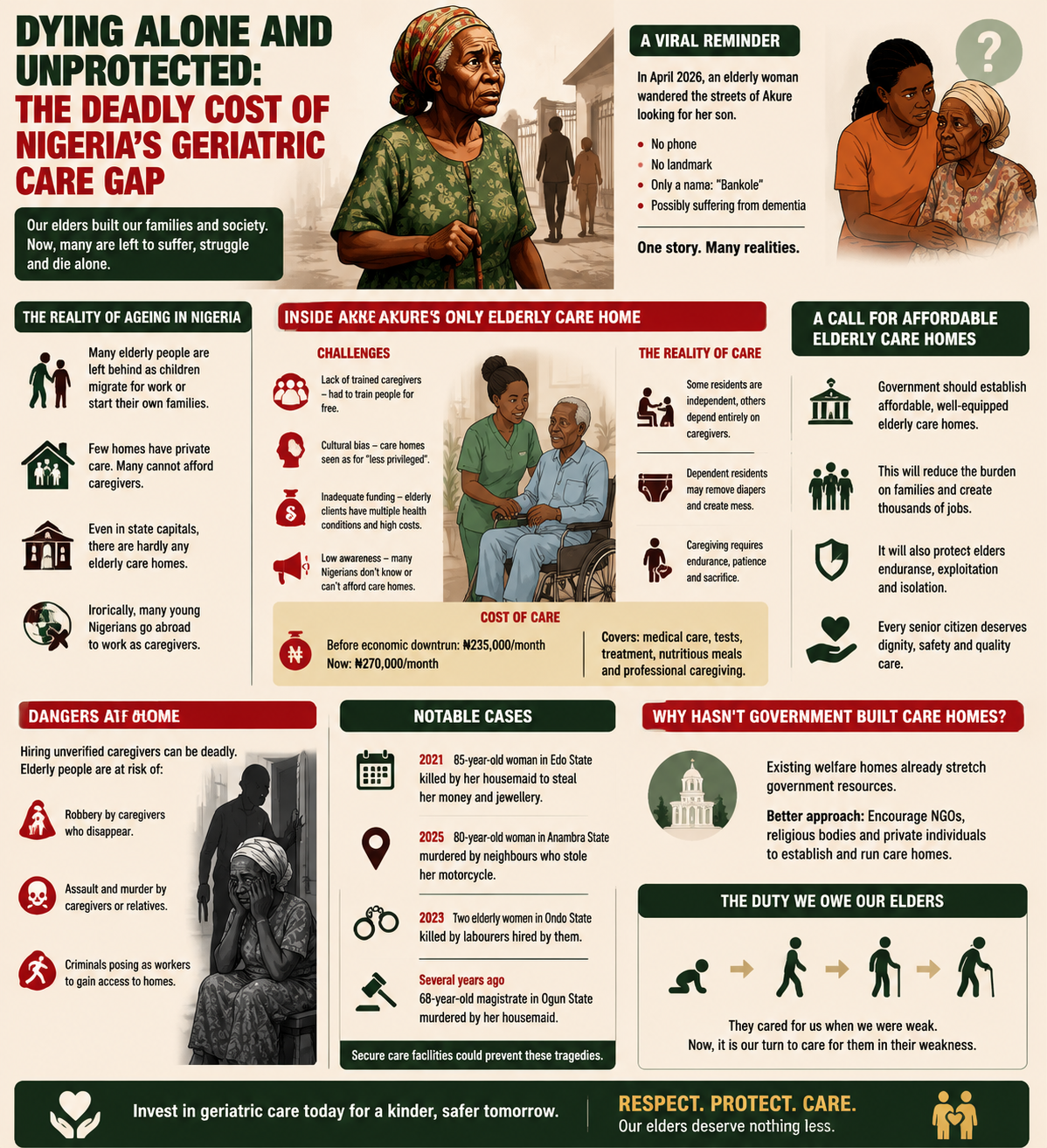
Sometime in April 2026, in Akure, the Ondo State capital, a video went viral on social media featuring an elderly woman, believed to be in her 70s, wandering around the gate of Orita-Obele Estate before residents noticed her.
After questioning her, she claimed to have lost her way back to Oda Road, where she had come from in search of her son.
She tried to describe the area on Oda Road, but all she could remember was that her son lived near a block industry, without any identifiable landmark to aid the description. She mentioned her son’s name only as “Bankole.”
From her appearance, she had no phone and seemed to be suffering from age-related challenges, possibly dementia.
Her case is one of the numerous instances of elderly people found wandering the streets of Akure and other parts of the country after losing their way in unfamiliar environments.
This is one of the devastating experiences and hardships some parents face in old age after their children have left home in search of better opportunities and to start their own families.
*Left behind: The reality of ageing in Nigeria*
What befalls parents in old age, whether good or bad, is often determined by the investments they made to sustain themselves later in life and by how successful and compassionate their children become.
Many elderly people who enjoy better living conditions after retirement either live with their children or have caregivers hired to look after them.
Caregiving is one of the professions many young Nigerians have relocated abroad to pursue, particularly in countries such as the United Kingdom and Canada, where greater priority is placed on the welfare of elderly people.
In those countries, children who prefer not to place their parents in public elderly care facilities often hire caregivers to attend to them in their own homes.
Meanwhile, in Nigeria, it is difficult to find even two elderly care homes in state capitals such as Akure.
Where such facilities exist, they are mostly managed by private individuals and receive limited patronage.
This underscores the low level of awareness regarding the need to provide safe havens for vulnerable elderly people.
*Inside Akure’s only elderly care home*
A visit to the only known elderly care home in Akure, G’anat Hospital and Elderly Care Centre, located in Oba-Ile, revealed the challenges involved in caring for older persons.
The Chief Executive Officer of the centre, Dr. Adesuyi Adeshina, said he was inspired to establish it because of his experience caring for his late mother.
“As her only son, I had a lot of difficulty finding a care home where she could be cared for because of the nature of my job. When I couldn’t find one, I decided to create one.”
Due to the low level of awareness and exposure surrounding the initiative, which also has economic potential, he said he experienced difficulties recruiting caregivers.
“The first challenge was getting the right staff. At the time, there were no trained caregivers in Nigeria. We trained people for free and then employed them.
“The second challenge was cultural bias. The prevailing perception in Nigeria at the time was that care homes were meant for less privileged people. We spent three years on Crest FM educating the public.
“The third challenge is inadequate funding, which I don’t think is peculiar to care homes alone. An average elderly client has at least three co-morbidities requiring routine medication and specialist attention. For many families, this has been difficult. We set up an NGO to assist, but we could only do the little we can.”
The centre’s manager, Miss Farayola, noted that caregiving requires considerable endurance and sacrifice, especially when caring for dependent elderly persons.
According to her, while some patients can still attend to their personal needs, others depend entirely on caregivers for feeding, bathing, and using the toilet.
She added that many Nigerians are unaware of the existence and benefits of elderly care homes, while many who are aware cannot afford the costs involved.
Highlighting the financial implications of enrolling a resident at the centre, she explained that before the economic downturn, the facility charged N235,000 per month per resident, but the fee has since increased to N270,000.
She said the fee covers medical services, including tests and treatment, as well as nutritious meals tailored to residents’ age and health conditions, alongside professional caregiving services.
“Those who are dependent are often difficult to manage. Some remove their diapers and litter the environment with waste.
“That is why some caregivers cannot cope and eventually resign. This challenge also contributes to why our facility cannot accommodate a large number of patients,” she explained.
Speaking on how society can better support elderly citizens in Nigeria, Dr. Adeshina said much still needs to be done.
“We need to invest more in geriatric care research, reduce healthcare costs for the elderly, and intensify public enlightenment on elderly care. As mentioned earlier, there should be free or subsidised healthcare for the elderly, greater public awareness, and increased funding for research focused on geriatric care.”
*A call for affordable elderly care homes*
A resident of Ondo State, Mrs. Helen Odofin, who longed for an affordable aged people’s home for her mother before her demise, called on governments at all levels to establish affordable care homes for elderly citizens, lamenting the absence of adequate support systems for aged people across the state and other parts of Nigeria.
Speaking on the challenges faced by families caring for elderly parents, Odofin said there was little or no government intervention targeted at senior citizens’ welfare.
She noted that while orphanages exist for children, similar facilities for the elderly are either unavailable or inaccessible to many Nigerians because of high costs.
According to her, many families are under immense pressure as they struggle to care for ageing parents, particularly those with health challenges.
She explained that the few elderly care homes available in Ondo State are beyond the financial reach of most pensioners and low-income earners.
“I think it is high time the government intervened by establishing separate homes for the aged. The only one I know operating in Ondo State is very expensive, and a pensioner cannot afford to commit an entire monthly allowance to caring for an elderly parent in such a facility.”
Odofin argued that government investment in elderly care homes would not only reduce the burden on families but also create employment opportunities for caregivers, health workers, and other support staff.
She added that many Nigerians living abroad are engaged in caregiving jobs, demonstrating the sector’s potential for job creation if properly developed in the country.
She further expressed concern over the growing trend of families relying on unverified caregivers, some of whom have been linked to human trafficking and fraudulent activities.
According to her, the lack of regulated and affordable elderly care centres has created opportunities for unscrupulous individuals to exploit desperate families.
She urged the government to establish well-equipped and affordable elderly care facilities, stressing that such centres would attract patronage and improve the quality of life of senior citizens.
*Assault on elderly people in their personal homes*
The risks involved in engaging strangers to care for elderly people in private homes go beyond financial fraud.
There have been numerous cases of elderly people found dead in their homes while hired caregivers, many of whom were uneducated housemaids, disappeared after looting their belongings and, in some cases, murdering them.
Because many of these housemaids are victims of trafficking from unknown locations and have no traceable family background, it becomes easier for them to perpetrate crimes against their employers.
Some elderly people have also been killed by relatives entrusted with their care or by members of their immediate communities.
One notable case involved the murder of the 85-year-old mother of the former Governor of Edo State, Madam Maria Igbinedion, in 2021. Her housemaid, Dominion Okoro, killed her in order to steal her belongings.
Upon her arrest, Okoro confessed: “I killed Mama to take her money. She did not offend me. While she was sleeping on her bed around 12:01 a.m. on December 2, 2021, I used a stool to hit her on the head. She shouted for help, but only the gateman was around and he did not hear her. Mama later died.
“I waited until 4:00 a.m. before leaving the house with Mama’s N100,000, wristwatch, and jewellery. I escaped to Cross River State, but I was later arrested by the police.”
In Anambra State sometime in 2025, an 80-year-old woman was murdered by two young men in her neighbourhood who stole her lady’s motorcycle and were later arrested.
Similarly, in Ondo State in 2023, two young men were arrested for killing two elderly women in Ore and Akure. The suspects were labourers hired by the deceased women. There was also a case involving a 68-year-old magistrate in Ogun State who was murdered by her housemaid some years ago.
These painful deaths might have been prevented if the victims had been residing in secure geriatric care facilities.
*Government involvement in geriatric care infrastructure*
Reacting to why the government has not established elderly care homes in Ondo State, a former Commissioner for Women Affairs and Social Development in the state, Mrs. Titi Adeyemi, attributed the situation to the existence of other welfare institutions already being managed by government and the financial burden associated with running them.
“Managing existing welfare homes places enormous pressure on government in terms of finance, personnel, management, and supervision. Rather, the government may prefer to encourage interested NGOs, religious organisations, and private individuals to establish such facilities,” she submitted.
*The duty we owe our elders*
Biologically, human beings begin to experience weaker muscles, reduced energy levels, and declining cognitive abilities as they age. Those suffering from one or more medical conditions often experience accelerated ageing and become increasingly dependent on others.
Elderly people gradually begin to exhibit characteristics similar to those of infants, requiring special attention and care. Consequently, they may become an additional responsibility for family members who are already occupied with their daily activities.
The elderly were once active contributors to the development of their families, communities, and society. It is therefore expedient to reward their contributions by providing them with adequate care, attention, and a conducive environment when their strength begins to decline.
Where it is not possible for family members to remain constantly by their side, there is a need for public geriatric care infrastructure as a safer alternative to protect elderly people from abuse, neglect, isolation, and solitary death.
First published in The Hope Newspaper edition of Friday 17th July, 2026 with the headline, Old Age : How not to live it and die

Leave a Reply