

..as UNICEF calls for better tracking of digital learning outcomes, bridging rural connectivity gap
Oyo State has become the 26th state in Nigeria to adopt the Nigeria Learning Passport, a digital learning platform designed to expand access to quality education for children and teachers.
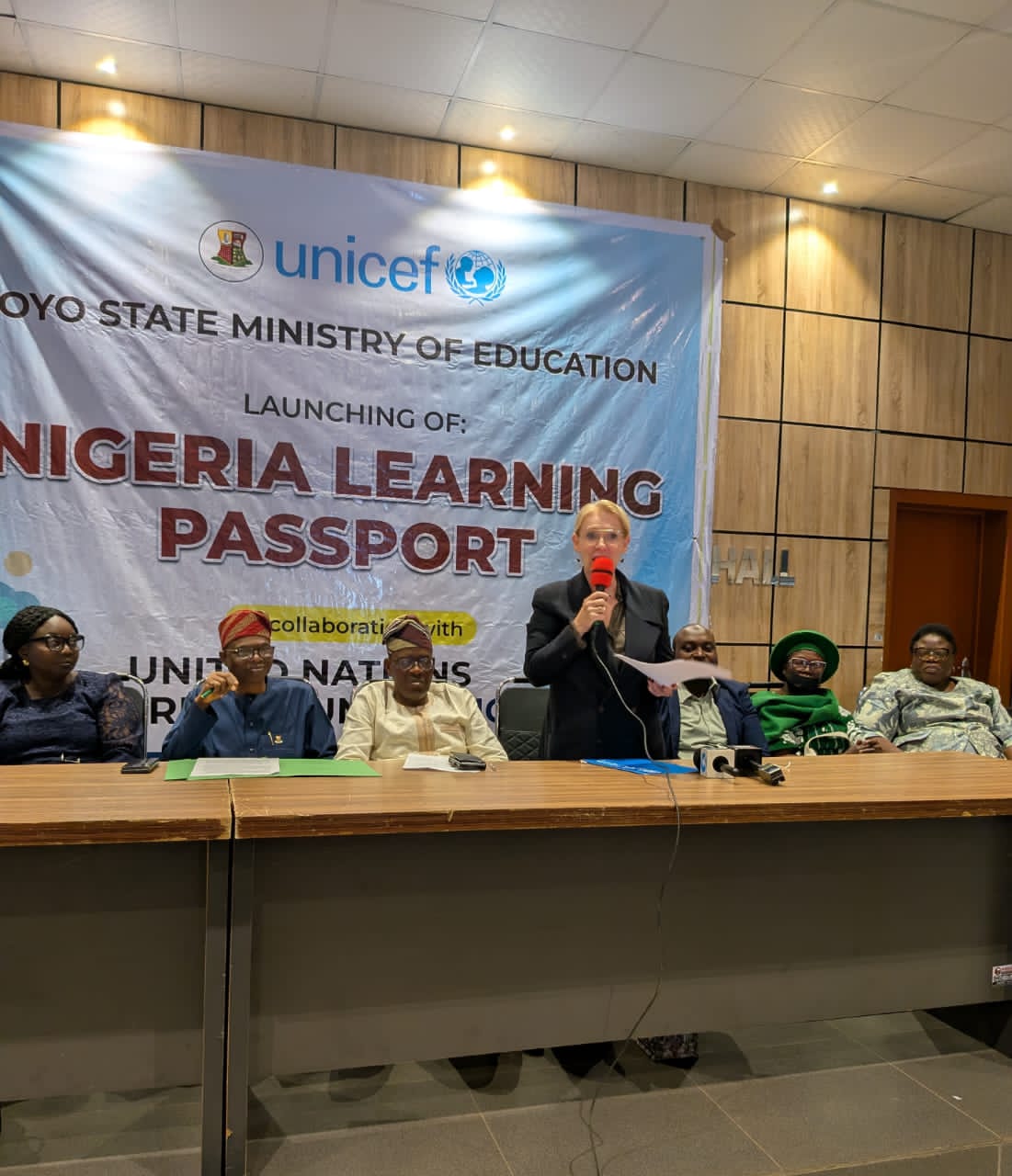
The UNICEF Lagos Chief of Field Office, Celine Lafoucriere, disclosed this on Wednesday at the launch of the Nigeria Learning Passport held at the Local Government Hall, Secretariat, Ibadan.
Lafoucriere said about 2.4 million children and teachers across Nigeria were already using the platform, describing its adoption by Oyo State as an important step towards fulfilling the state government’s commitment to providing quality education for every child.
She commended Governor Seyi Makinde for his leadership, particularly the recruitment of 5,000 new teachers who, according to her, were now positioned in classrooms to support more children through the digital learning platform.
She said the Nigeria Learning Passport provides thousands of curriculum-aligned lessons in Mathematics, English and Science, which can be accessed through phones and tablets both online and offline.
According to her, Airtel covers the cost of data usage, allowing families to access the platform without paying for the data required to use it.
Lafoucriere explained that the platform was developed in response to the disruption to education caused by the COVID-19 pandemic, when schools were shut worldwide, leaving more than 1.6 billion children unable to attend classes physically.
She noted that the platform enabled children to continue learning through mobile phones, radio and other channels, including in areas with limited or no internet connectivity.
The UNICEF official said the Learning Passport was the product of collaboration between UNICEF, the Federal Government and development and private-sector partners.
She identified Microsoft as the developer of the technology platform, while the Global Partnership for Education provided financial support, IHS Towers supported connectivity infrastructure, TECNO provided devices and Airtel covered data costs for users.
Lafoucriere said UNICEF was responsible for ensuring that the learning content aligned with the Nigerian curriculum, was available in languages understood by children and was supported with teacher training.
She, however, urged the Oyo State Government and other stakeholders to prioritise rural and underserved communities in the implementation of the platform.
“Let us reverse that trend by deliberately prioritizing children in these communities, especially girls, so that those who face the greatest barriers are among the first to benefit,” she said.
She also called for sustained teacher training, stressing that newly recruited teachers should receive the knowledge and support required to integrate the platform into classroom teaching and learning.
Lafoucriere further urged stakeholders to monitor the use of the platform and its impact on learning outcomes rather than measuring success solely by the number of registrations.
She said stakeholders should determine whether children were actively using the platform, whether learning outcomes were improving and whether challenges relating to connectivity, devices and data access were being identified and promptly addressed.
She expressed optimism that children in communities such as Saki and Iseyin would be among those accessing the platform and benefiting from its resources.
“Those children are the reason this platform exists. Their learning, progress, and opportunities are the outcomes that truly matter,” she said.

Leave a Reply