
By Dr. Betty Anyanwu-Akeredolu, PhD
Darlin,
It’s me, your adorable Betty.
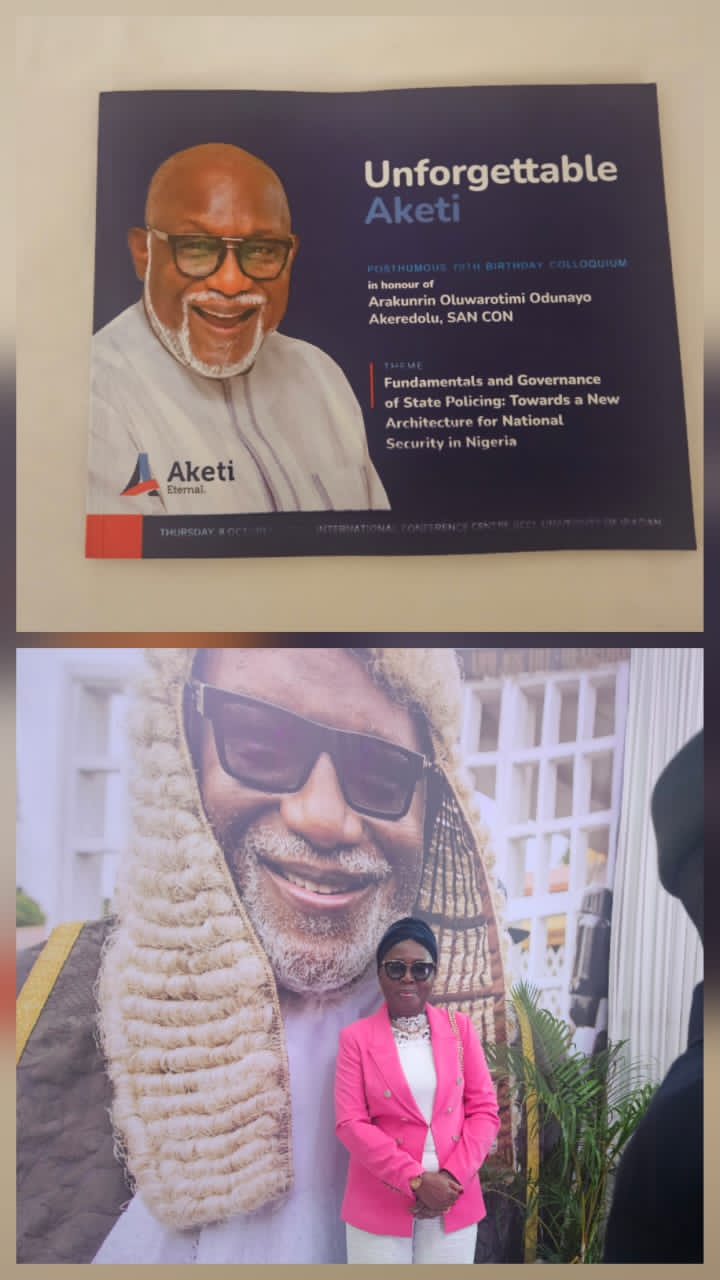
Once again, I find myself speaking about you in the past tense. I still struggle with that. Perhaps I always will. Your departure remains, to me, something I have not completely understood. I know what happened. I know that you are no longer physically here. I know that I cannot pick up the phone and call you, hear your voice, argue with you, laugh with you, or simply sit beside you in companionable silence.
Yet, somewhere inside me, it still feels like a dream. A very long dream. And I sometimes wonder: for how long? Perhaps this is what grief does to those who have loved deeply. It does not follow a timetable. It does not obey logic. It simply becomes part of you.
Our marriage was not perfect. How could it have been? Two strong personalities, two different backgrounds, two different ethnicities, two very different temperaments were brought together by love. We had our disagreements. We had our difficult moments. We sometimes drove each other to the edge. But we worked it out. Because beneath the arguments was something stronger: love. We built a family. We raised children. We shared dreams. We endured storms. We celebrated victories. We mourned losses. We grew together. And through it all, you remained my Aketi. You were not merely my husband. You were my friend, my intellectual sparring partner, my sounding board and, sometimes, my most formidable opponent. You once told the people of Ondo State that they voted for one but got two. You meant it. We were a team.
And nowhere was that partnership more consequential than in the years when you took up the question of security and the future of Nigeria’s federal structure.
I SAW THE JOURNEY FROM CONVICTION TO ACTION
Today, this gathering is about state policing. For many Nigerians, state policing is now a policy proposition to be debated in conferences, legislative chambers and political circles. For you, Aketi, it was never merely an academic proposition. It was lived reality. You understood the fundamental contradiction in asking a governor to take responsibility for the security of citizens within his state while denying that governor the constitutional and operational tools necessary to respond effectively to threats within that same territory. You often challenged the logic of that arrangement. And you did not merely talk about it.
You acted.
I was there. I watched you become increasingly convinced that Nigeria’s security architecture had to be rethought. I watched the conversations, the consultations, the arguments and the resistance. I watched you insist that security must have a local face. I watched you argue that those who live in a community understand its terrain, its people, its peculiarities and, often, its security threats better than a distant command structure can.
And I watched you move from advocacy to institution-building.
That journey ultimately contributed to the emergence of the Western Nigeria Security Network, Operation Amotekun. The creation of Amotekun was not simply about establishing another security outfit. It represented an idea that communities should not be helpless spectators when their people are threatened; that regional cooperation can strengthen security; that the state must be capable of responding to threats in ways that are informed by local realities, and, fundamentally, that Nigeria’s security architecture must evolve with the security challenges confronting its people. Aketi was particularly passionate about this. He believed that the security of the farmer walking to his farm, the woman travelling home after dark, the child going to school, the trader returning from the market and the community defending its livelihood could not be left entirely to a distant, overstretched structure. He believed that government must be closer to the people. That belief was not born in a conference hall. It was born from observing Nigeria.
THE AMOTEKUN MOMENT
There was a point when the idea of Amotekun seemed almost impossible. There was opposition. There were legal and institutional questions. There were political disagreements. There were those who questioned the necessity of regional security cooperation. Aketi persisted. He was never one to retreat simply because an idea was inconvenient. His legal training perhaps reinforced that instinct in him: identify the problem, interrogate the principle, test the boundaries and, if necessary, fight. And fight he did.
He understood that the security question could not be separated from the larger question of true federalism.
For him, state policing was part of a bigger national conversation. What kind of federation do we want?
What powers should belong to the centre? What responsibilities should belong to the federating units? How do we make government more responsive to the people?
How do we create accountability when the person politically responsible for security does not have commensurate operational control? These were not abstract questions to him.
They were questions about the survival and security of ordinary Nigerians. The significance of his advocacy has also been recognised by others who worked with him and knew his public record. Tributes following his death specifically identified his advocacy for state police, restructuring and the establishment of Amotekun as important parts of his national contribution.
I WAS THE WOMAN BESIDE THE MAN
But today, I do not want to speak only about the Governor. I want to speak about the man I knew when the cameras were gone. I saw the determination. I saw the frustration. I saw the nights when public responsibilities followed him home. I saw the telephone calls. I saw the arguments. I saw the moments of triumph.
And I saw the price of leadership. People saw Governor Akeredolu.
I saw Aketi.
The man who could be fierce in public and incredibly tender in private.
The man whose booming voice could fill a room, but whose laughter could equally fill our home. The man who could disagree with me passionately and, moments later, sit down to eat with me as though nothing had happened. That was our marriage.
Real. Human. Imperfect.
Beautiful. We were two strong people who chose, again and again, to make our marriage work.
And we did.
That is why losing you has been so devastating. I did not lose merely a Governor.
I lost my husband. My companion. My friend.
My children’s father. The man with whom I spent the greater part of my adult life.
And yet, somehow, I have continued. Perhaps because you taught me not to surrender.
WHY I REMAIN IN THE TRENCHES
People sometimes wonder why I remain active in politics. They ask why, at this stage of my life, I continue to put myself in the trenches. The answer is simple. It is not because I have nothing else to do.
It is not because I cannot find another life. It is because politics, public service and the struggle for a better Nigeria became part of the life we shared.
By remaining engaged, I remain connected to you.
I still hear your voice in my head. I still imagine what you would say about the issues confronting us. I still anticipate your arguments.
I still imagine the mischievous smile that would appear when you knew you had made a particularly strong point.
And yes, I believe you are cheering me on wherever you are. Maybe heaven.
You were a believer. So I choose to believe that somewhere beyond this physical world, you are watching. And perhaps, occasionally, shaking your head at me.
YOUR WORK IS NOT FINISHED
Aketi, you left before the conversation you started could reach its conclusion.
That is perhaps the greatest pain for those of us who knew how deeply you believed in these ideas. You challenged Nigeria to reconsider its security architecture. You challenged the concentration of power at the centre. You challenged the assumption that the existing arrangement was adequate simply because it had existed for decades. You insisted that Nigeria could do better. Today, this colloquium is evidence that the conversation did not die with you.
That matters. Because a legacy is not simply a list of things a person accomplished while alive.
A legacy is also the conversation that continues after the person has gone: questions that refuse to disappear, the ideas that continue to challenge us,
the institutions that survive their founders, and the young people who inherit the responsibility to carry the work forward. Amotekun is therefore more than a memorial to Aketi. It is a reminder that Nigerians can identify a problem, organise around it and create new responses to old challenges.
But we must also be honest.
Creating a security institution is only the beginning. The harder questions remain. How should state policing be structured? Who should exercise operational control? How should recruitment be conducted?
What standards should govern training? How should intelligence be gathered and shared? How should state and federal security agencies coordinate? How should funding be provided sustainably? How do we prevent political abuse?
How do we protect human rights? How do we ensure professional accountability?
How do we build public trust? And how do we make sure that state policing becomes an instrument for protecting citizens rather than another avenue for intimidating them? These questions matter because security without accountability can become another form of insecurity.
Aketi would have understood that. He was a lawyer. He understood institutions. He understood power. And he understood that power must be accompanied by responsibility.
THE ARCHITECTURE MUST BE NATIONAL, BUT SECURITY MUST BE LOCAL
The debate about state policing should therefore not be reduced to whether Nigeria should simply create more police forces. The deeper question is:
What security architecture best serves a complex federation of more than 200 million people? A centralised system has its strengths. But Nigeria’s security challenges are increasingly complex, geographically diverse and locally specific. The security realities of Ondo are not identical to those of Borno.
Those of Imo are not identical to those of Katsina.
Those of Lagos are not identical to those of Zamfara. A credible national security architecture must therefore combine national coordination with local responsiveness. There must be clearly defined constitutional responsibilities. There must be professional standards.
There must be inter-agency cooperation. There must be intelligence sharing.
There must be independent oversight. There must be mechanisms for preventing abuse. And there must be consequences for misconduct. That, to me, is the direction in which the conversation must now move. Not merely state police. But responsible, professional, accountable and community-responsive policing within a genuinely federal security architecture.
That is the conversation I believe Aketi wanted Nigeria to have.
A PERSONAL PROMISE
My love, I do not know what the future holds. I know only that life changed irreversibly when you left. Sometimes I still wake up and for a fleeting moment forget. Then reality returns. But I have learned that grief and purpose can coexist. I can miss you terribly and still continue the work. I can cry for you and still stand. I can speak about you in the past tense and still feel your presence. And I can carry your memory without being imprisoned by it.
You spent your life fighting for causes you believed would make Nigeria better.
So I will not allow grief to become an excuse for surrender. I will continue to speak. I will continue to participate. I will continue to challenge. I will continue to serve. Not because I am trying to become you. There was only one Aketi.
I remain Betty, your adorable Betty.
But I carry with me the lessons of the life we shared: your courage, your forthrightness, your stubborn refusal to surrender an idea simply because it was difficult,
your belief that public office should mean public service, and your conviction that Nigeria can, and must, do better.
REST, MY LOVE
Today, as Nigeria gathers to discuss one of the causes to which you devoted considerable energy, I feel two emotions simultaneously. I feel the ache of your absence. And I feel immense pride: pride that I was your wife; pride that I witnessed the journey; pride that I saw the man behind the public persona; pride that I know the conversations that preceded some of the decisions that are now part of Nigeria’s national history; and pride that the conversation you helped ignite continues.
Your physical presence is gone. But your questions remain. Your arguments remain. Your courage remains. Your Amotekun remains. And the national conversation about a more responsive security architecture continues.
Perhaps that is how a public servant truly lives beyond death—not merely through monuments or ceremonies, but through ideas that refuse to die.
So, Darlin, wherever you are, I hope you are watching. I hope you are smiling. And I hope you know that your adorable Betty is still in the trenches. Still standing. Still fighting.
Still carrying on. Until we meet again.
Rest on, my love.
Rest on, Aketi.
Your legacy lives.
#AketiEternal
Adorable Betty
Dr. Betty Anyanwu-Akeredolu, PhD ( Ada Owere I, Ada Emeabiam II)


Recent posts
About
JATS Online Newspaper is a trusted digital news platform under JATS Communications, delivering original, timely, and solution-focused journalism across Southwest Nigeria
Follow Us
Designed with WordPress
Leave a Reply