

By Chigozie Victor
Like other types of infrastructure projects, road construction opens communities to economic progress, development, and overall improvement in the quality of life. However, this has not been the case for Kilankwa 1, a community on the outskirts of Nigeria’s Federal Capital Territory (FCT), Abuja.
In 2021, Wadata Group arrived in the quiet community for the construction of a 4-kilometre road; however, the joy and sighs of relief that welcomed their arrival soon turned into sorrow and mourning after the construction company abandoned the road project halfway.
Recently, I journeyed to Kilankwa 1 to expose the abandonment of the road project (for which public funds have been disbursed) and spotlight the human costs of this abandonment.
Hajara Muhammed felt her world spin and shatter the day her 17-year-old son, Nasiru Yusuf, died; it felt like a fever dream, yet it had happened.
It was just like any other day. Nasiru had returned from school from neighbouring Kilankwa 2. He had joined her on the farm and left afterwards for his job outside as a security guard. He was supposed to return home to her again, except he didn’t.
While he rode his motorcycle to work, he tried to dodge an approaching car from the opposite side of a junction, but he couldn’t. The pull of the road was stronger than he could resist, so he unsuccessfully tried to dodge the car, but it hit him, and he fell headfirst to the ground.
A dazed Hajara rushed to the scene of the accident, where she and her older son, Abdurrahman, took Nasiru to a hospital in nearby Gwagwaada.
Nasiru died before he could receive any treatment.
As Nasiru’s body went cold, so did Hajara’s. The only difference is she’s still alive… Barely.
“…He was still in school. Just in SS1 (Senior Secondary School), He used to sing. He wanted to be a musician,” Hajara told me, wringing her hands.
“I truly miss him. He was a musician, and he earned a little money from it, which we used to buy food. We ate and drank from what he provided. Sometimes he would go to occasions, and once he started singing there, they would give him food, and he would bring some back for us,” she said, explaining that her little family fed well because of him, even though he was only a teenager.
Nasiru’s older brother, Abdurrahman, misses him dearly too, and he is deeply concerned about his mother’s well-being following his death.
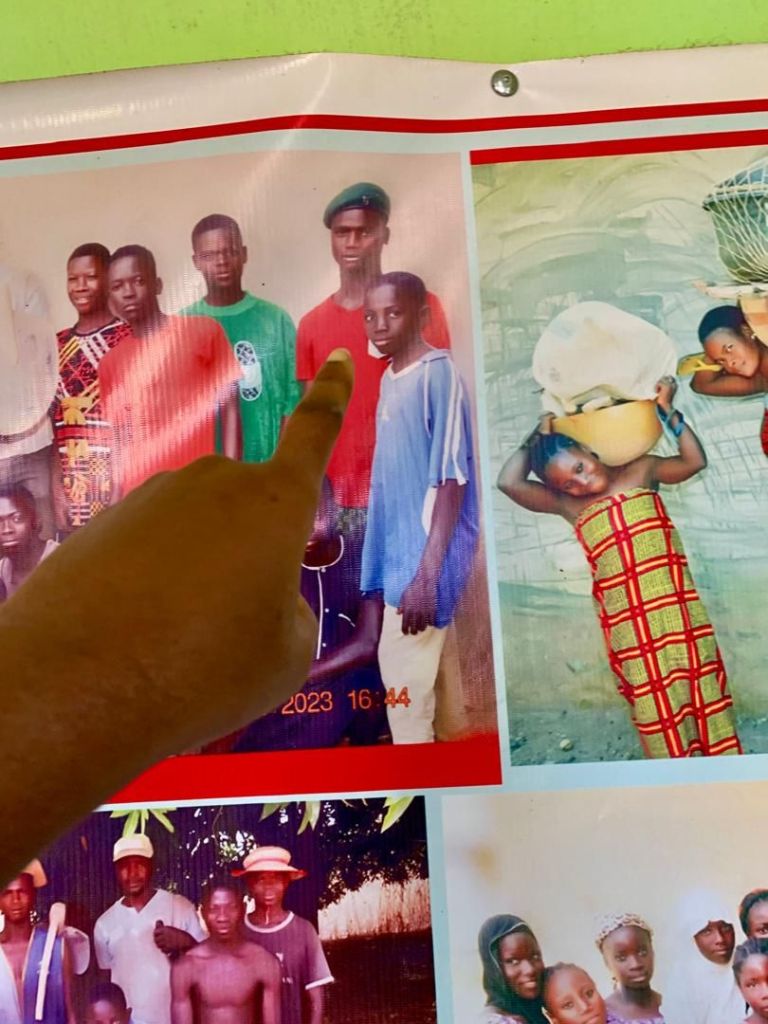
“My mother always asks about him. Even the day before yesterday, when we went to the farm together, she kept on crying, saying we would have finished at the farm faster and gone home. She said his absence on the farm was disturbing her, so I consoled her, telling her to leave everything in God’s hands,” he recalled.
“He was buried there,” Abdurrahman said, pointing towards a bush path.
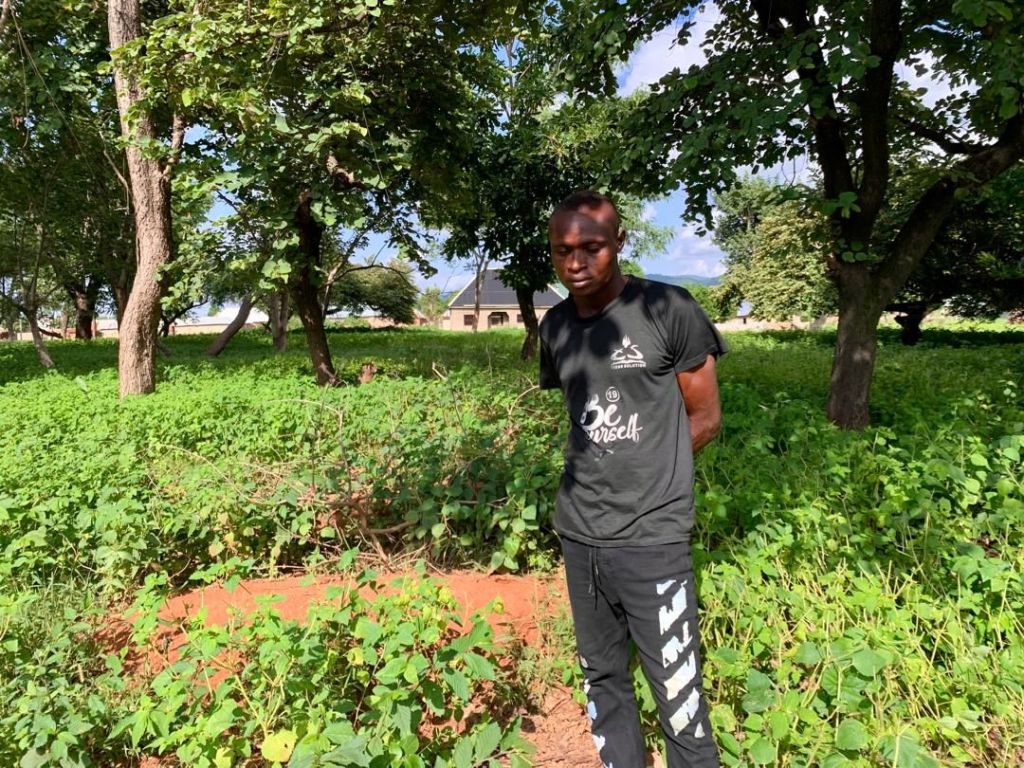
As he walked to Nasiru’s grave, Abdurrahman recounted how his late brother would not eat unless he was sure Abdurrahman had something to eat too; how joyful he was and how he spread it throu⥜gh his music, and how loving and kind he was.
“He had no problem at all; he was such a happy boy. He was so happy,” Abdurahman continued, explaining how they would gist among themselves, bantering over school and politics, and how all of that has drastically changed because their home is devoid of joy.
Beyond his own grief, Abdulrahman feels helpless about his mother’s. A huge part of her had died with Nasiru, and he did not know how to bring her back to life. He had watched helplessly as grief weakened her, snuffing life out of her small food business. Though she farms now and takes up side hustles, she still struggles financially and is eaten up by the discomfort of being unable to provide for her in the way that he wants to.
“Sometimes, she will say ‘I don’t see him, I don’t see him,’ but I will say, ‘he’s dead, you can no longer see him,” Abdurrahman said.
Hundreds of Millions of Naira Down the Drain?
Kilankwa road used to be an endless stretch of unpaved earth. Four years ago, when residents of the community learnt that the road had been earmarked for construction, they brimmed with excitement. Their long-held prayer for a tarred road to drive the economy of the community was finally being heard. But the honeymoon would not last.
Many residents of the farming community continue to tell tales of hardship, especially during rainy periods when the road turns into a death trap, becoming a nightmare and casting a bleak shadow on the area.
Data from BudgIT’s govspend showed that a sum of ₦332,924,114.69 (Three hundred and thirty-two million, nine hundred and twenty-four thousand, one hundred and fourteen naira, sixty-nine kobo) was disbursed to Wadata Group Limited for the construction of the road.
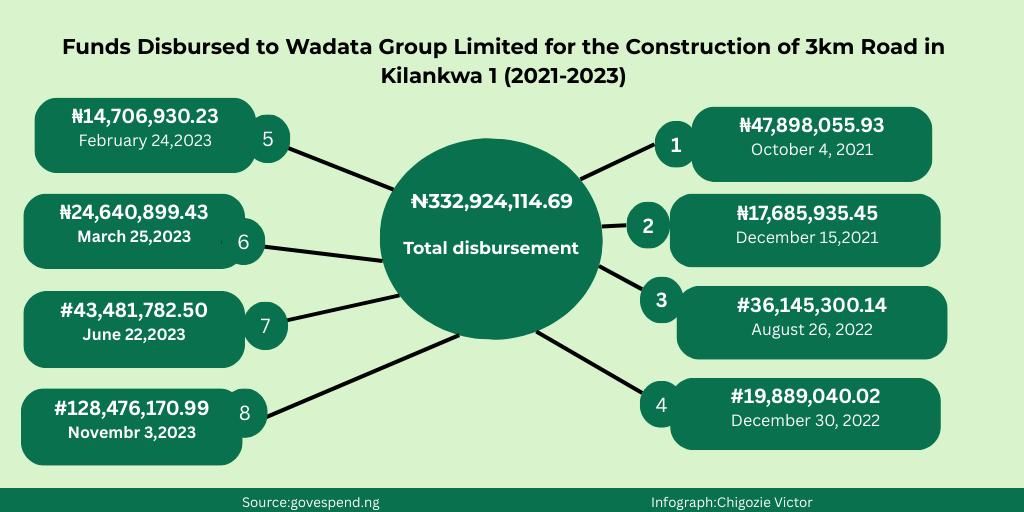
On one of the days this reporter visited Kilankwa, it would be hard to convince a ‘newcomer’ that the road had gulped hundreds of millions of Naira in public funds to construct just a few years back
As the motorcycle I boarded drove past the community signboard, a stretch of untarred road lay steeply ahead. Its surface wore large patches of cracks, and the gravel worn away from neglect. The motorcycle shook from the effect of the gravel as small pieces of the stones occasionally skidded off, even as the motorcyclist tried to dodge the potholes.
The contractor only constructed the connecting bridge and graded the road before a truckload of gravel was poured onto its surface. However, what was supposed to bring relief for Kilankwa was abandoned halfway.
“They (contractor) took their things and left,” Haruna Musa, a resident of the community, chipped in. “We expected to see them come back to complete and transform it to a normal tarred road, but they never did,” Haruna said, explaining that the gravel caused the road to pull people in a way that made them lose control of their vehicles.
The road that keeps taking
Jibrin Shuaibu knew the roads all too well. He had seen the gravel pull people to the ground, leaving them bloodied and scarred. Each time, he counted himself lucky and prayed he would never get caught in its grip.
For a while, he didn’t. But one Saturday morning in 2024, Jibrin headed out to the market on a commercial motorcycle (Okada). As the motorcyclist navigated the treacherous road, he spotted a vehicle approaching from the opposite direction. Its tyres skidded as the driver fought to steady it against the gravel’s pull.
Not wanting to stake their lives on the probability of the other driver’s success, the motorcyclist swerved sharply to the left, but the loose stones pulled him down; the motorcycle slid out of his control. Jibrin and the passenger behind him fell violently to the ground, leaving them badly injured.
Jibrin does not remember much of what had happened in the instant following the crash, but he remembers feeling like the bone in his leg had shattered. He was taken to the Specialist Hospital in nearby Gwagwalada. When it was clear he was not getting any better, he was taken to Birnin Kebbi, Kebbi State, where his leg healed.
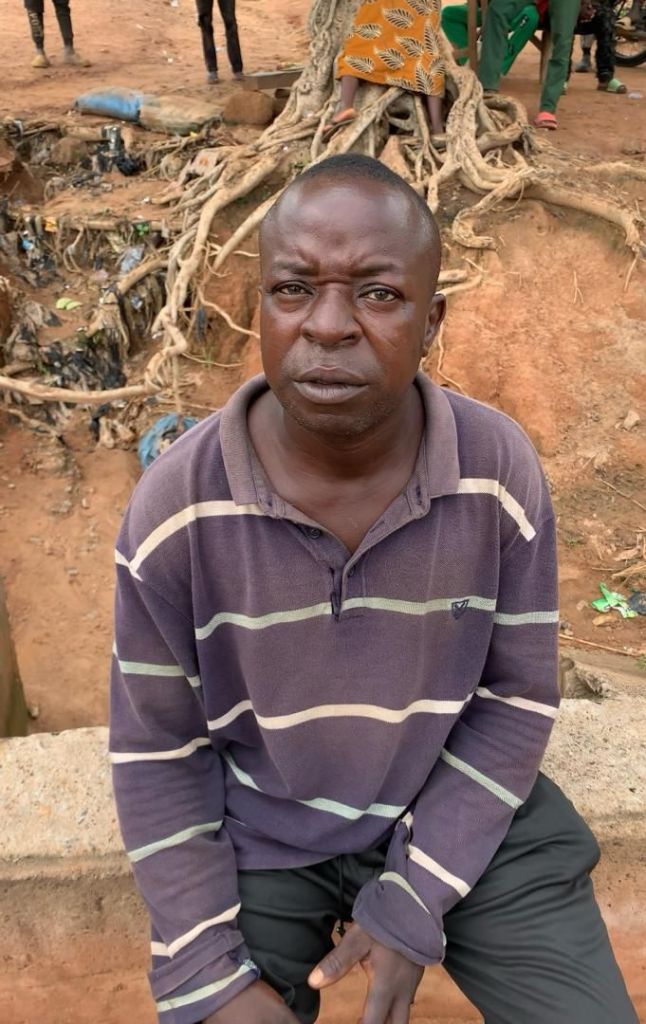
In the weeks that followed, Jibrin not only suffered a hit to his health and finances, he also had to watch helplessly as his family suffered.
“That time, there was food scarcity in my home because all the money I had was being put towards my recovery. I had some land I purchased before, but I sold it and gathered the money for treatment. My children were starving; there was nothing to eat. Some people were helping me financially, chipping in where they could because of the situation I found myself in,” he remembered.
Though Jibrin’s incident happened a year ago, he continues to suffer both physically and financially. While he is able to relieve the physical pain by taking medication from time to time, he cannot do much about his finances. Once combining interstate driving with farming, he now drives sparingly within Abuja, “I used to go to Kogi, Nasarawa, Minna, and Jos, or anywhere my movement carries me. But since this incident happened, I can’t go interstate any longer. I just go to Zuba, Suleja, and Abaji.”
“I farm (to make up for finances). It doesn’t really affect me there because I can be threading softly. Also, when I have some money, I pay some people to go and do the heavy lifting for me,” Jibrin said, his eyes fixed to the ground.
“We didn’t abandon the road”
After several visits to the Wadata Group’s office, the chairman, Alhaji Umaru Wakili, told our reporter that contrary to the community’s claims, his company did not abandon it.
“We were contracted to do surface dressing, and we have completed the scope of the job. There’s surface dressing and there’s asphalt. That road is surface dressing, not asphalt done with concrete.
“Anywhere there’s surface dressing, you see stones on the road,” Wakili explained, emphasising that surface dressing is usually done to make bare roads usable.
Wakili went further to explain that his company was asked to construct a bridge to waylay the water which caused recurring flooding in the community and made the road hard to use especially during the rainy season.
“Jobs are given in phases. After this surface, we were supposed to be awarded the one for asphalt, but unfortunately, it didn’t come that way. That road was a constituency project. I don’t know why, but sometimes, the government takes time to award the completion of roads like this,” he said, emphasising again that his company rehabilitated the road as they were contracted to do, and did not abandon the road.
But is Wakili right?…
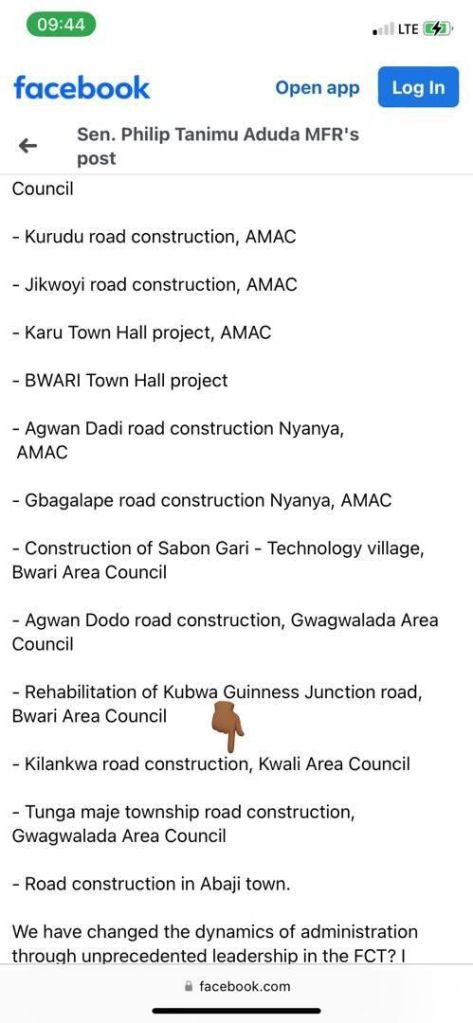
The road was constructed in 2021. At the time, Senator Philip Tanimu Aduda represented the Federal Capital Territory (FCT) and, in extension, Kilankwa 1.
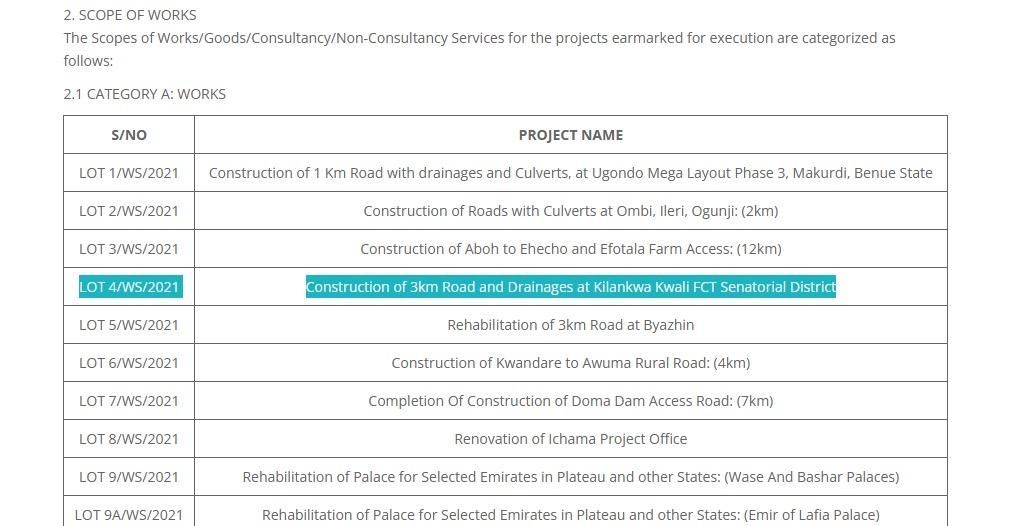
Meanwhile, a look at the scope of work of the project published on public procurement.ng listed the project as Construction of 3KM Road and Drainages. It did not specifically mention Surface Dressing, as stated by Wadata Group.
To further investigate Umar Wakili’s claims on the scope of work awarded to his company, the reporter revisited the payment details provided by BudgIT’s govspend platform. This time, it’s noted that five of the eight payments the company received from Lower Benue RBDA had Surface Dressing in their descriptions. The rest were titled Construction of 3KM Road and Drainages at Kilankwa, Kwali FCT Senatorial District.

According to this, Wakili’s claims about the scope given to him do not exactly check out.
Wakili’s company was also contracted to construct drainages in addition to the road. However, this was not seen in the community. Instead, a culvert was constructed.
Michael Olufemi, an expert in civil engineering, said that the contractors did not fulfil that part of the project, as culverts and drainages are two distinct things.
“Culverts are different from drainages. A culvert is the box-like one that water passes under, while drainage is the one that water flows into.”
“Drainage is better known as a gutter in local language,” said Olufemi, poking holes into the amount spent on the road. Olufemi mentioned that the amount of money seen on govspend.ng (₦332,924,114.69) could not have been earmarked for surface dressing alone, as it was sufficient to cover both phases of road construction— surface dressing and asphalt.
“As of 2021, that money should have done more than surface dressing. I will put asphalt on that road with that amount (at the time).”
“Things were cheaper at the time, unlike now. Now, things are almost five times the price they used to be,” Olufemi said, expressing surprise that a constituency project was concluded at the surface dressing level.
Experts weigh in
Though the Chairman of Wadata Group Limited dismissed the accidents and deaths recorded in the community since the construction of the road, our findings offered a glimpse into the danger residents of the community have been contending with
Studies have shown that several authorities declare surface dressing as a safe form of road construction. Durham County Council, for instance, describes it as the major type of surfacing “ideal for all roads.”
Surfacedressing.com lists provisions for skid-resistant surface and waterproofing of road (to prevent water ingress, reduce cracks and prevent potholes), as some of its benefits.
No source seemed to flag surface dressing as remotely dangerous; they did, however, state that it is important that it is unsafe to fast traffic immediately after it is laid, recommending that temporary signs be put in place, asking road users to drive at low speed. When asked if the constructors installed such signs or educated them about speed limits, the community members could not confirm this.
While speaking on the possible cause of the numerous road accidents in Kilankwa 1, Engineer Michael Olufemi affirmed that speeding immediately after the road is constructed could indeed lead to accidents.
“When this gravel is still new, and you are speeding, you can lose control. In fact, even a trailer can miss control because when you want to match brakes, the gravel will speed you up because there is no frictional contact to the ground; it is the gravel that is helping you to move,” he said, explaining that speeding when the road gravel is yet to settle into the Bitumen could be the cause of the accidents.
“They (the contractors) could have introduced bumps in the community to reduce their speed limit, seeing as it’s a community that is not familiar with this,” he said.
But when Olufemi was told that the accidents still happened as recently as July 2025, and shown photos and videos of the road, his stance immediately changed.
“They (the Kilankwa community) are right,” he said, referring to their description of the road as having a pull, forcing their hands and making things as little as braking and turning difficult to the point of road clashes.
“Idachaba Adejo, a Civil Engineer with many years of experience, agreed with Olufemi. He mentioned that “ surface dressing has never been a source of accident to anybody. I’m even surprised to hear a community saying they are having accidents because of surface dressing,” he said, going into a detailed explanation of the processes involved in surface dressing.
“It is an aspect of road dressing done to give way for a larger one in the future..
“…The chippings (gravel) to be used are fine chippings: If they used bolder materials, then it’s a serious concern because they are supposed to use fine chippings,” he said.
Upon hearing that some of the gravel skids off the road, Adejo speculated that the size used was not the recommended size.
His conviction became stronger when he heard the community’s description of the road as having a pull.
“I can confidently tell you that the chipping they used for that construction is not the normal chippings you use for surface dressing. Surface dressing chippings are so fine (little) that they will be buried inside the bitumen, which was sprayed and bonded, so that they form a layer on their own and are buried,” he said.
Trapped in silence
Besides the wrong size of chippings used in constructing the road, a good part of the road is now riddled with potholes, a situation which Engineer Emmanuel Olufemi attributed to the lack of a proper drainage system.
Speaking on the road’s condition, Olufemi emphasised that a new road must be constructed for the community as a matter of urgency.
“This road is already gone,” he said.
But is a new road possible in the nearest future? It does not appear so, at least, not according to the explanation given by Tracka’s Communication Officer, Ademide Ademola.
Explaining how constituency projects are nominated, Ademola stated that it could be particularly difficult for a legislator to successfully clinch funds for all phases of a road project that they consider important.
“Sometimes, they have to wait for another budget cycle to come because that’s when the project can be accommodated in the budget.”
But can the Kilankwa 1 community afford to wait it out?
This report was supported by the Wole Soyinka Centre for Investigative Journalism (WSCIJ) under its Report Women Female Reporters Leadership Programme (FRLP)
 ..all about information services
Leave a Reply