
Stakeholders in the media industry continue to express concern about the barriers preventing women in the profession from attaining leadership positions, particularly in the newsroom.
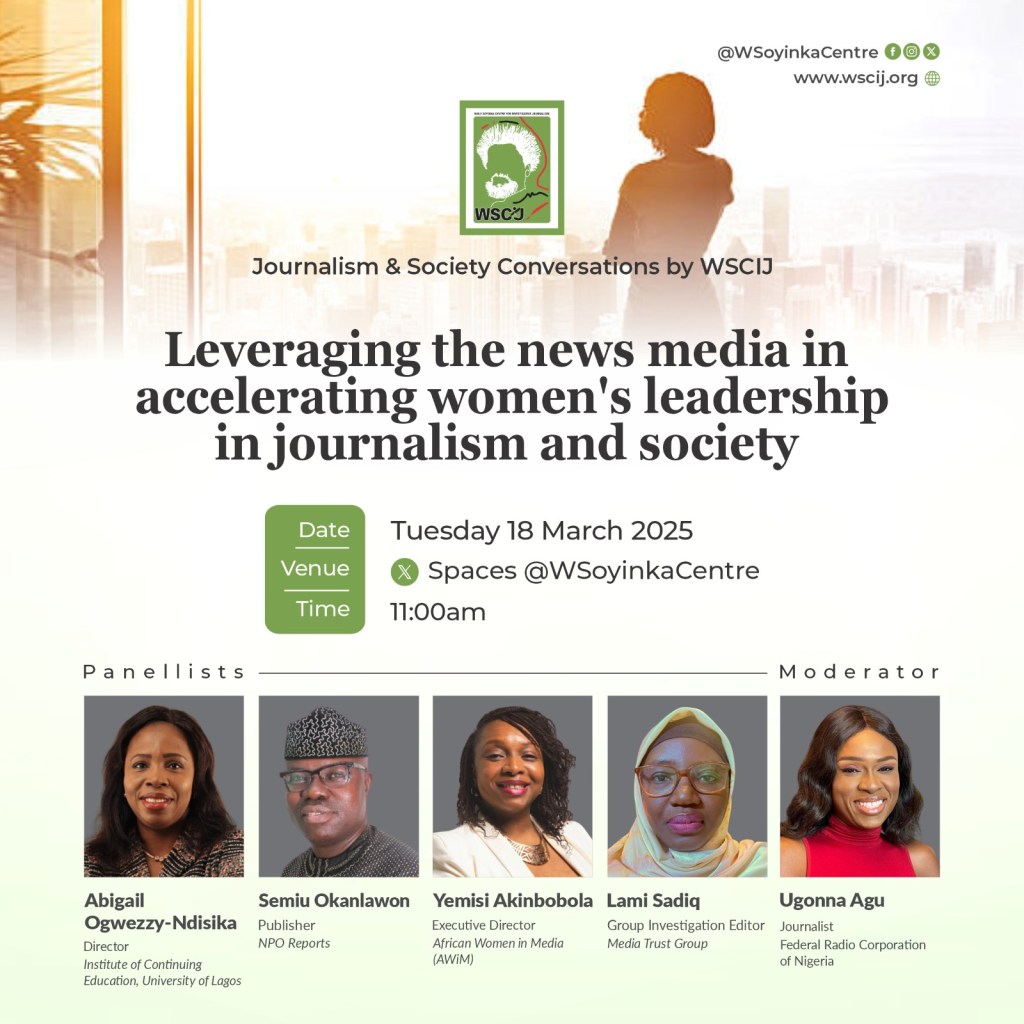
This concern was raised by guest speakers during a Journalism and Society Conversation held to commemorate this year’s International Women’s Day. The event, organized on X Space by the Wole Soyinka Centre for Investigative Journalism (WSCIJ) on Tuesday, March 18, focused on strategies to advance women’s leadership in journalism and society.
Themed “Leveraging the News Media in Accelerating Women’s Leadership in Journalism and Society,” the conversation centered on tackling systemic barriers and achieving fair representation of women in media leadership and society as a whole.
Speaking at the event, the Group Investigations Editor at the Media Trust Group, Lami Sadiq, decried the low percentage of women in leadership positions in newsrooms, noting that there is still a long way to go in achieving fair representation.
Describing the situation as quite demoralizing, she revealed that a recent WSCIJ report indicated that women hold only 26% of newsroom leadership positions across Nigeria.
“That is a total failure. It tells us that more needs to be done. We are nowhere close to where we should be,” she declared.
However, she affirmed that the few women in leadership positions within the media industry are performing exceptionally well, demonstrating that women are more than capable of handling such roles.
“There are more women in journalism who are willing to take on major responsibilities. Those beats that were traditionally seen as a ‘boy’s club’ are now being covered by women, and we are beginning to see positive outcomes despite all the challenges. Women are rising to the challenges in the newsroom, but they are not getting the necessary support from the system.”
Also speaking, the Executive Director of African Women in Media (AWIM), Yemisi Akinbobola, acknowledged the reality of gender disparity in media organizations, particularly in leadership positions.
She noted that the media environment is not enabling enough for women in the profession, adding that it is an undeniable fact that barriers such as stereotypes and sexual harassment continue to hinder women’s career growth.
On the need to sanitize the media space and promote professionalism, the Director of Continuing Education at the University of Lagos, Abigail Ogwezzy-Ndisika, called for the training of bloggers on journalistic ethics and their integration into the media system.
Another guest speaker, Semiu Okanlawon, the publisher of NPO Reports, urged media organizations to create more opportunities for women and encourage young women to join the profession. He highlighted the achievements of notable women in the industry, noting that they are making significant contributions.
Lekan Otufodunrin of the Media Career Development Network emphasized the need for media organizations to adopt gender policies to guide their operations and ensure equal opportunities for women in leadership.
 ..all about information services
Leave a Reply