
By Muhammad Abdul-wahab
Introduction: The Price of Freedom
Today, when looking back at how our fore- fathers fought for our Independence from colonial rule which was solely tied in slavery. The word “independence” isn’t just an ordinary word but a word that carries weight, soaked in the sweat and sacrifice of generations.
Historically, on October 1st, 1960, when Nigeria finally unshackled itself from colonial rule, many Nigerians today thought it was only for power transformation but it wasn’t just a political transfer of power. It was the birth of a dream, a chance to prove that a nation so richly blessed with resources, culture, and people could govern itself, chart its own path, and thrive among the community of nations. Permit me to quote here, the late Dr. Nnamdi Azikiwe, Nigeria’s first president,who once declared thus: “Independence is an opportunity, not a bed of roses. It is a call to duty and service.”
For the thousands who danced in the streets of Lagos that October day, waving green-white-green flags with hearts full of hope, to them , independence meant dignity. It meant we Nigerians could finally decide our future, free from the dictates of colonial masters. Sir Abubakar Tafawa Balewa, Nigeria’s first Prime Minister, once publicly stated that : “We are grateful to the British people but our day has come. We must now live as free men and women.”
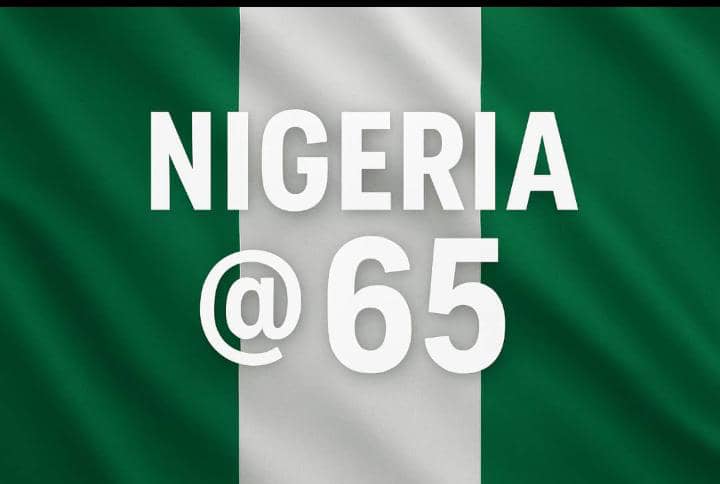
Today, sixty-five years later, we stand on the shoulders of those dreams. Yet, as we celebrate 65 years today are we still a baby or an adult ? What have we done with this freedom?
The Achievements: A Nation That Refuses to Fall
Making way with some of our achievements so far..Despite the odds, Nigeria has recorded achievements worth celebrating. We are a giant not only by population but by influence. With over 200 million people, we are the most populous Black nation in the world, a cultural powerhouse whose music, film, and literature shape narratives across continents. From the Afrobeat sounds of Fela to Burna Boy winning the Grammy, from Chinua Achebe’s Things Fall Apart to Chimamanda Ngozi Adichie’s Half of a Yellow Sun, Nigeria continues to give the world voices that inspire.
In sports, our athletes have flown the flag high, from the 1996 Olympic football triumph to Tobi Amusan shattering world records. In innovation, Nigerian tech hubs are leading Africa’s digital revolution, with startups solving real-life problems in fintech, health, and education.
Above all, our resilience is unmatched. Each time the country has staggered—whether during the civil war of 1967–1970, the dark years of military dictatorship, or recent economic recessions which has never occured before were faced during the recent Executive president Bola Ahmed Tinubu .However, Nigerians have risen, refused to give up, and pushed forward. This resilience is perhaps our greatest achievement: the ability to endure, survive, and still find joy amid trials.
The Challenges: The Weight We Carry
Yet, as every Nigerian knows, independence has not been without pain. The promise of 1960 has too often been eclipsed by the failures of leadership, the poison of corruption perpetrated by all, and the burden of insecurity.
Our economy, though rich in oil and natural resources, is still shackled by mismanagement. Poverty continues to rise, inflation eats into salaries, and young graduates often face years of unemployment. As of 2025, the naira has tumbled, the cost of living is now the curse of living , and families struggle to put food on the table sours over and over again.
As if that is not enough, Insecurity haunts many regions. From insurgency in the North-East to banditry in the North-West, from kidnappings in the South to unrest in urban centers, ordinary Nigerians live with uncertainty and in fear day in day out . The land that should nurture dreams is today often feels hostile to them. Then are we free or still in slavery???
Nevertheless,the unity we celebrated in 1960 is frequently tested by ethnic, religious, and political divisions. Yet, we must remember: the strength of Nigeria lies not in the fragmentation of its people but in the harmony of its diversity.
_Freedom Redefined: Lessons for Today_
True independence, sixty-five years later, as we celebrate today is no longer about waving flags or singing the anthem. It is about whether we have achieved freedom from poverty, ignorance, corruption, tyranny, and oppression. Independence is hollow if a farmer cannot feed his family, if a student cannot afford education, or if a citizen lives in fear on their own street.
The Qur’an reminds us:
“إِنَّ اللّهَ لا يُغَيِّرُ مَا بِقَوْمٍ حَتَّى يُغَيِّرُوا مَا بِأَنفُسِهِمْ”
“Indeed, Allah will not change the condition of a person until they change what is in themselves.” (Qur’an 13:11).
Similarly, the Bible advises: “Righteousness exalts a nation, but sin is a reproach to any people.” (Proverbs 14:34).
Both scriptures remind us that independence is a moral task. It demands justice, honesty, and accountability. Without these, the sacrifices of 1960 are now becoming an empty history lesson.
The Role of Youth: Carriers of Tomorrow’s Torch
Imperatively, nigeria’s future rests heavily on the shoulders of its youth. With over 60% of our population under the age of 30, this demographic is not just the leaders of tomorrow, they are the leaders of today. They are the innovators building apps, the activists raising their voices, the students striving despite strikes, the young entrepreneurs hustling in markets and online platforms.
But youth must channel their energy beyond protests and hashtags. We must enter the spaces of decision-making, not only demanding accountability but embodying it. As the late Chinua Achebe once wrote: “The trouble with Nigeria is simply and squarely a failure of leadership.” If this is true, then the cure lies in raising a new generation of leaders who will serve, not exploit.
The Arab Spring showed us how young voices can shake nations, but it also showed us the need for constructive leadership after the noise. Nigeria’s youth must not only cry out for change but also prepare to govern with integrity when that change comes. The question is: can we youth do it better ?? What do I have to do better than the oldies ??
Hope Beyond the Hardship
It is easy to drown in despair when we look around—at the rising cost of food, the long queues for fuel, the insecurity that disrupts daily life. But despair is not the spirit of Nigeria. Our history is proof. When the civil war ended in 1970, predictions of collapse loomed, yet Nigeria healed. When dictators held us down, democracy returned. When Ebola and the deadly Corona Virus threatened, we united and conquered it.
Hope is not blind optimism. It is the stubborn belief that despite today’s hardship, tomorrow can be better if we act rightly. It is the refusal to surrender to cynicism. It is choosing to plant seeds of honesty, kindness, and innovation, even in rocky soil.
Call to Action: Building the Nigeria We Dream Of
As we mark Independence Day in 2025, let us not merely celebrate the past. Let us commit to shaping the future. Let leaders remember that their titles are not for enrichment but for service. Let citizens remember that change and charity begins at home—in how we treat one another, in rejecting corruption, in being diligent wherever we find ourselves.
Most importantly, let the youth rise. Rise not only in anger at what is wrong but also in responsibility to make it right. Rise in classrooms, in fields, in offices, in ballot boxes. Rise to the challenge of building the Nigeria of our dreams.
Independence is not an event. It is a process, renewed every day by the choices we make. As long as Nigerians still hope, still work, still believe, then the green-white-green will not just be a flag—it will be a promise.
Conclusion: A Prayer for the Nation
Nigeria at 65 is a paradox of pain and promise. But as the late Tafawa Balewa Awolowo once prayed on Independence Day: “This country, which God has placed in our hands, may He give us the wisdom to govern it well, the strength to protect it, and the humility to serve it.”
May this be our prayer today.
May we rise beyond selfishness.
May we find unity in diversity.
May we build a Nigeria where freedom is not only political but personal, economic, and spiritual.
Happy Independence Day, Nigeria. The journey is hard, but the dream lives on.
Recent posts
Quote of the week
"People ask me what I do in the winter when there's no baseball. I'll tell you what I do. I stare out the window and wait for spring."
~ Rogers Hornsby
About
JATS Online Newspaper is a trusted digital news platform under JATS Communications, delivering original, timely, and solution-focused journalism across Southwest Nigeria
 ..all about information services
Leave a Reply