
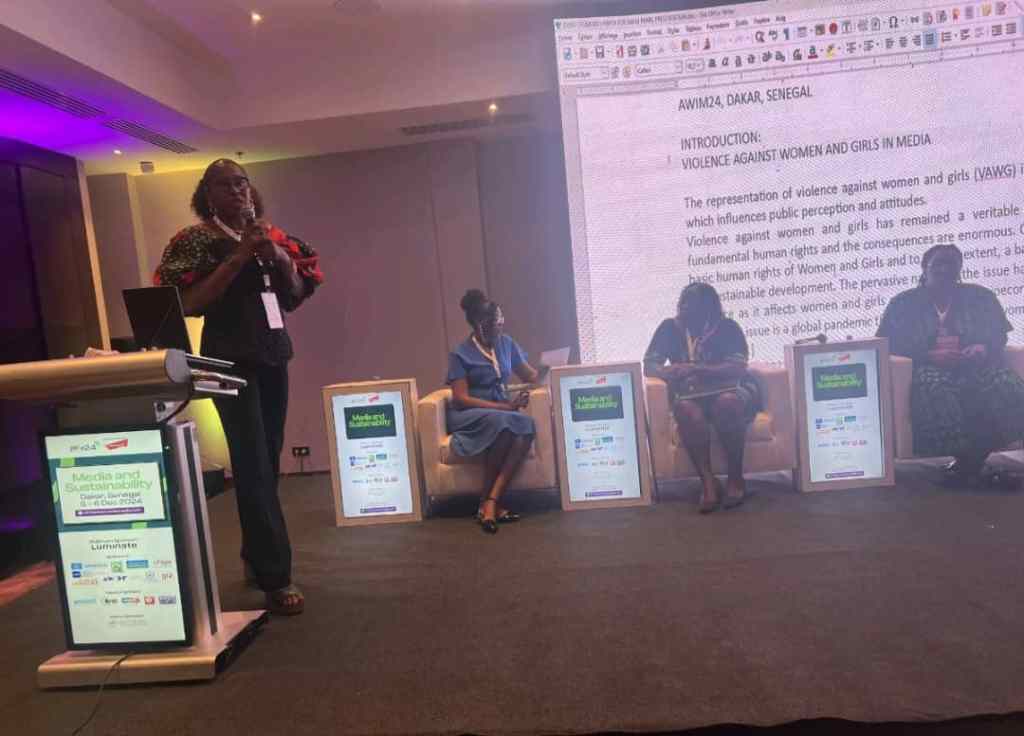
A PAPER PRESENTED BY MRS DORIS OLUMOKO AT THE AFRICAN WOMEN IN MEDIA CONFERENCE, AWIM24, DAKAR, SENEGAL ON THE 5TH OF DECEMBER, 2024.
INTRODUCTION:
VIOLENCE AGAINST WOMEN AND GIRLS IN MEDIA
The representation of violence against women and girls (VAWG) in African media is a critical issue which influences public perception and attitudes.
Violence against women and girls has remained a veritable challenge to issues relating to fundamental human rights and the consequences are enormous. Contextually, it is a violation of the basic human rights of Women and Girls and to a great extent, a barrier to achieving gender equality and sustainable development. The pervasive nature of the issue has shown no respect to boundaries and race as it affects women and girls of all ages and socioeconomic status as well as women in media.
The issue is a global pandemic that affects 1 in every 3 women in their lifetime. [Source: WHO, March 2021]
In September 2023, UN Women reported that “no country is within reach of eradicating intimate partner violence” and that we as a global community are “failing women and girls.”
Data shows that incidents of violence against women and girls are on the rise. Every humanitarian crisis, armed conflict, communal riot, pandemic, and human-made and natural disaster results in more incidents of violence perpetrated on women and girls:
As many as 58% of women have been exposed to online violence, making cyberviolence one of the most prevalent and widespread forms of violence against women. [Source: Institute of Development Studies, 2021]
The Global Database on Violence against Women shows that, 22.3% of women in Nigeria experience lifetime physical and/or sexual intimate partner violence, while 43.4% of young girls are victims of child marriage and 19.5% of young girls are victims of female genital mutilation (UN Women, 2022) There are several cases of women who have lost their lives through intimate partner violence.

In the Media context, African media often portrays VAWG in:
1. Sensationalized reports, emphasizing graphic details. ( The use of videos and pictures of victims in reportage should not be encouraged in the media)
2. Stereotypical and victim-blaming narratives. ( Emphasis of Media reports should be on the perpetrators, not the victims)
3. Limited or inaccurate representation of survivors’ experiences. ( The Media should strive to get survivors to tell their stories)
4. Perpetuation of harmful gender stereotypes.
The Consequences of this are
1. Normalization of VAWG.
2. Reinforcement of harmful gender norms.
3. Stigma and shame for survivors.
4. Limited public understanding of VAWG complexities.
In Nigeria, some widows and their children suffer violence as they are subjected to harmful traditional practices while others are denied access to the property rights of their late husbands, leaving them and their children to suffer in abject poverty and penury.
A typical example of this happened in Akure, Ondo State, when maternal family of a deceased spouse, arrested his widow in a bid to confiscate the land she inherited from her late husband.
It took the media’s intervention to get the woman out of the claws of her in-laws. How did we succeed in our interventions? It was through media narratives and constant reportage of the story that led to public outcry. With collaboration with Legal Practitioners, the widow had her property back.
There was also the very pathetic case of a four year old girl who was beaten to death by her Parents on accusation of Witchcraft. Again it took the intervention of the Media to get justice for the late child, her step father who actually beat her to death ran away while the mother of the child is serving her jail term.
Violence against women and girls has ripple effects that reverberate in the society. It destabilizes families, disrupts communities, and undermines social cohesion. Studies have shown that children who witness violence in their homes are more likely to experience poor mental health outcomes and engage in violent behavior themselves growing up, thereby, perpetuating the cycle of abuse in future generations.
How do we as Women in Media change these narratives?
We could achieve the sustainable development practices through the constant reportage of such societal ills and taking proactive measures and follow up such stories to conclusions.
Ensure women and girls are portrayed as people, not just victims of violence, in all stories.
Use more women experts as sources for our stories.
Report on efforts to address gender inequality and violence against women and girls and why they are so important.
Report on efforts to address toxic masculinity and men’s roles in ending inequality.
There is also a need for African Women in Media to join the Global Call for a new Optional Protocol to the Convention for the Elimination of All Forms of Discrimination against Women (CEDAW). This global treaty dedicated to ending violence against women and girls is the most expedient path to ending this violence and creating a safer world.
MULTIDIMENSIONAL IMPACTS
I touched briefly on the impacts of violence against women and girls but let me expand on those points and how a new Optional Protocol to CEDAW can help.
The impact of violence against women and girls is multi-dimensional, extending far beyond the individual survivor. It has not only inflicted physical harm but also leaves lasting emotional and psychological scars. It robs women and girls of their autonomy, dignity, and sense of security, perpetuating cycles of fear and trauma.
This issue is not only devastating for survivors of violence and their families, but also entails significant social and economic costs.
In some countries, violence against women is estimated to cost up to 3.7% of their GDP – more than double what most governments spend on education. Many times, violence against women and girls imposes significant economic costs on the society, especially in Nigeria, where I come from. It leads to lost productivity, increased healthcare expenditures, and strains on social services. It hinders women’s participation in the workforce and limits their economic potential, perpetuating cycles of poverty and inequality.
Failure to address the issue of violence against women and girls also entails a significant cost for economic growth of nations. One characteristic of gender-based violence is that it knows no social or economic boundaries and affects women and girls of all socio-economic backgrounds: this issue needs to be addressed in both developing and developed countries.
A new mechanism could include metrics-based reporting in the form of a scorecard, which would increase the effectiveness of implementing proven interventions.
The Media have a key role to play in this regard by reporting all forms of Gender Based Violence in their locality, setting the agenda for government and stakeholders to rise up to their responsibility of entrenching a global binding framework which is needed now to make the world safer for women and girls. Women and girls cannot wait, the time is now.

PROVEN INTERVENTION
Decreasing violence against women and girls requires a community-based, multi-pronged approach, and sustained engagement with multiple stakeholders. The most effective initiatives address underlying risk factors for violence, including social norms regarding gender roles and the acceptability of violence.
Addressing the complex development challenge of gender-based violence requires significant learning and knowledge sharing through partnerships and long-term programs.
There’s hope however, in spite of these grim realities, because we have seen proven interventions that can make a difference in preventing and addressing violence against women and girls. This intervention is education which is paramount as it empowers individuals to recognise and challenge harmful gender norms and stereotypes from a young age.
It is against this backdrop that a new Optional Protocol can help, as it would mandate interventions proven to lower rates of violence including: that countries must strengthen laws and policies to hold perpetrators accountable and ensure justice for survivors. This includes improving access to legal aid, establishing specialized courts and support services, and promoting the implementation of international human rights standards.
It is also essential to invest in support services for survivors to assist them in healing and rebuilding their lives through access to safe shelters, counseling, and economic empowerment programmes.
By addressing the root causes of violence, such as poverty, inequality, and discrimination, the global community can create more equitable and just societies for all.
In fact, engaging men and boys as allies in this fight is crucial because promoting positive masculinity and challenging toxic notions of manhood can help create a culture of respect and equality where violence against women and girls is not tolerated. Since violence against women and girls is a complex issue with far-reaching consequences, by working together across sectors and borders, we can create a world where every woman and girl can live free from fear and violence.
I urge us all, to stand united in our commitment to ending this injustice and building a more equitable and just world for all.
An International Legal Framework in the form of A new Optional Protocol to CEDAW to end violence against women and girls will achieve prevention and protection for women and girls, and a paradigm shift away from violence toward thriving for women and girls, nations and communities, everywhere.
The time to act is now!
Join the call at everywoman.org
 ..all about information services
Leave a Reply