
By Muhammad Abdul-wahab
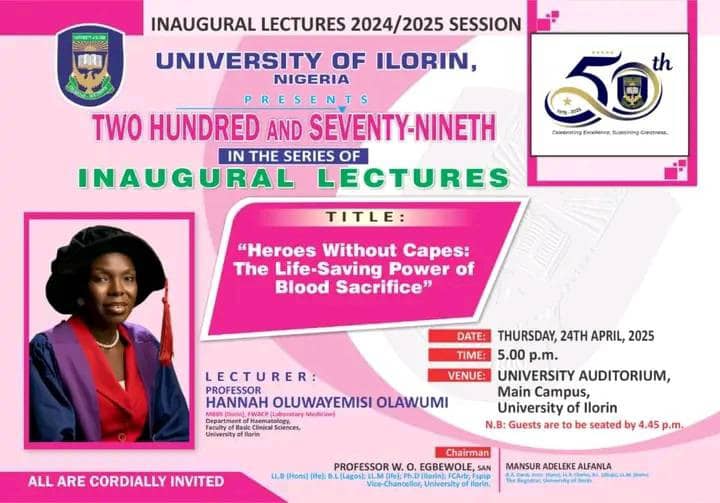
“Together, we can build a world where no one has to die because they cannot get the blood they need to survive.” These were the powerful closing words of Professor Hannah Olayemisi Olawumi, who delivered the 279th Inaugural Lecture of the University of Ilorin on Thursday, April 24, 2022, at the university auditorium.
The lecture, titled “Heroes Without Capes: The Life-Saving Power of Blood Sacrifices”, was not only the first inaugural lecture from the Faculty of Basic Clinical Sciences, but also the very first in the Department of Haematology, marking a significant milestone in the institution’s academic history.
The event drew over 1,000 attendees including staff, students—especially from the Faculty of Clinical Sciences—dignitaries, relatives, and well-wishers.
The Vice Chancellor, Professor Wahab Egbewole (SAN), alongside other principal officers of the university, was present to grace the occasion.
In her lecture, Professor Olawumi, a seasoned haematologist, highlighted the critical role of haematology, describing it as a specialized branch of medicine dedicated to the study of blood and blood-forming organs, as well as the diagnosis, treatment, and prevention of related disorders.
She emphasized her research focus on blood transfusion, donors, and donations, urging the public to appreciate the unseen heroes—voluntary blood donors—whose anonymous acts save countless lives.
“When we think of heroes, we often picture caped crusaders,” she said. “But in reality, the true heroes are ordinary people who donate blood selflessly. Their acts of kindness are silent, yet profound in impact.”
According to her, blood is vital for human survival. It transports oxygen and nutrients to tissues, helps remove waste, and plays an essential role in fighting infections and facilitating healing. She cited a statistic that blood travels approximately 12,000 miles within the body and pumps around 2,000 gallons daily.
Professor Olawumi stressed that someone around the world needs blood every second, referencing New York Presbyterian Health Matters (2025). Despite being a cornerstone of medical treatments, blood remains in dangerously short supply—particularly rare types like O-negative.
She mentioned several groups heavily reliant on blood transfusions: women with postpartum hemorrhage, cancer and leukemia patients, individuals with sickle cell anemia, and those undergoing major surgeries or organ transplants.
Beyond saving lives, she outlined the health benefits of blood donation. These include:
– Reduction of excess iron in the body.
– Lower risk of certain cancers.
– Routine health screening during donation.
– Lower risk of depression.
– Increased longevity for regular donors.
“The need for blood is urgent and constant. We cannot afford to wait for a crisis before recognizing its importance,” she concluded. “Become a hero. Donate blood. Multiply your impact.”
In attendance were family members of the lecturer—her mother, husband, children, and close relatives. Prominent academics such as Professor Adeoye, Professor Ibikunle, Professor P.O. Ajiboye, Professor Babatunde, and the former university librarian, Professor Abdulwahab Isa Olanrewaju, also showed support.
Professor Olayemisi’s compelling lecture serves not only as an academic achievement but as a clarion call to all Nigerians: voluntary blood donation is an act of humanity that transcends recognition—it is the gift of life itself.
 ..all about information services
Leave a Reply