
By Muhammad Abdul-wahab Damilola
Religion once a beacon of hope , unity and where the society find solace and peace has been reduced to a laughing stock in the society, often use to cause chaos and political conflict in our community . Unfortunately to say, some clerics who are suppose to be the ethical preachers and torchlight for the society are becoming a bitter pill to swallow. Once upon a time, the pastor’s pulpit and the imam’s minbar and voices were places of healing, unity, and purpose. Today, however, that same voice is often entangled in political propaganda, corruption, fraud, self-centered schemes, and heartbreakingly, violence. As society looks inward, asking why conflict festers and morality decays, one culprit is frequently and unfairly blamed and dragged to the gallows it is none other than religion.
Conversely, it’s worth examining the impact of religion on our lives. Are its institutions and leaders fostering a sense of community, compassion, and purpose? Or are they inadvertently perpetuating division, dogma, and harm? The answer lies in the stories of individuals and communities touched by faith. For some, it shows that religion provides a framework for moral guidance, comfort, and belonging. For others, it can be a source of pain, exclusion, or oppression. But the question one must ask: is it constructing us—or destroying us?
Historically, religion served as society’s moral architecture. The Charter of Medina, signed under the Prophet Muhammad ﷺ, remains a gold standard for religious pluralism. Likewise, the early Church established schools, hospitals, and orphanages across Europe and Africa. But simultaneously, religion has also been manipulated—from the Crusades to colonial missionaries who baptized with one hand and stole land with the other.
In Nigeria, the twin forces of religion as both constructive sanctuary and destructive tool are more evident than ever. While mosques and churches still feed the hungry and shelter the homeless, a new generation of clerics have embraced politics over piety, and profit over principles.
Tragically, some self-proclaimed men of God – imams, Alfas, pastors, and evangelists – have traded their spiritual calling for material wealth. Their pursuit of riches has led them down a path of corruption, deceit, and exploitation, leaving their congregations vulnerable and disillusioned. Then, is it Men of God or merchants of Gold ?
The recent scandal involving a young cleric in person of Abdulrahman Bello, an Ilorin based citizen once revered for his Islamic eloquence, was suspected to have killed and dismembered the body of his claimed girl friend , shattered the lifeless body part into pieces and sell across to individuals in Nigeria . Likewise, Pastor Simeon Eze, a self-proclaimed prophet from Enugu, was arrested in 2022 for orchestrating ritual killings under the guise of divine revelation.
And then there’s “Daddy G.O, “Big Imam” syndrome, where certain pastors live in multi-million-naira mansions, drive bulletproof SUVs, and fly private jets—all funded by their “flock,” many of whom cannot afford a three-square meal. These modern-day spiritual capitalists camouflage under holy robes while bleeding the masses dry.
Consequently, many now question not just the clerics—but the religion they represent.
> “My pastor said I must sow a ₦100,000 seed or my breakthrough won’t come. Is that religion—or business?” asks Ugochi, a Lagos-based hair stylist.
> Rasaq, a 22-year-old student from Kwara, shared:
> “Our local Imam said it was haram (unlawful) to smoke but I caught him smoking . Is that well enough ?” These views posited that such betrayals fuel a dangerous narrative: if religion breeds corruption, then religion itself must be corrupt.
Simultaneously, the digital world has become both courtroom and coliseum for religious discourse. On X (formerly Twitter), threads mocking religious doctrines go viral. The sacred texts are a joke On TikTok, comedy skits portraying “Pastor Zaddy” or “Alfa Wonti Gbo” reduce sacred figures to caricatures. YouTube channels dig up every scandal and livestream ever failing. Religion, once veiled in sanctity, is now meme fodder in our society .
But digital satire often breeds hostility. Recently, a Christian TikToker mocked the Qur’an’s laws on inheritance, prompting a wave of angry duets and threats. A Muslim skit maker retaliated by calling the Holy Trinity “mathematically absurd,” igniting another storm. These micro-conflicts spiral into macro-animosity—turning screens into cyber-war zones.
And what’s the result?
Young Nigerians, increasingly disillusioned, begin to associate faith with fraud, dogma with division. While religion still saves lives in quiet corners, it loses credibility in the trending hashtags.
Blaming Religion for Human Atrocities Is a crime
Whenever tragedy strikes, people often rush to pin the blame on religion. A husband beats his wife and quotes scripture? Blame the Bible. A terrorist bombs a market and shouts “Allahu Akbar”? Blame the Qur’an.
Yet, as Ali Mazrui once argued, “Religion is not guilty when the faithful misbehave.”
Indeed, religion offers timeless ethics—but men often twist them for temporal gain. The Qur’an commands justice, yet warlords invoke it to justify extremism. Jesus preached peace, yet colonizers wielded the cross like a sword.
To blame religion for the acts of its worst representatives is like blaming medicine for the deaths caused by quack doctors.
Even among believers, unity has fractured. Sunni vs. Shi’a. Catholics vs. Pentecostals. Tijaniyyah vs. Salafiyyah. Theological disagreements escalate into fistfights and Facebook wars. In some communities, interfaith marriages are still condemned. In others, sectarianism fuels school segregation.
The tragic case of the Sokoto mob lynching in 2022, where a Christian student was accused of blasphemy and killed by her Muslim peers, revealed the toxic mix of ignorance, mob mentality, and weaponized religion. The government’s tepid response only emboldened extremists.
Similarly, clashes between Christian and Muslim youths in Jos, Kaduna, and parts of Benue have turned communities into combat zones—where worship centers are burned, and children inherit hatred with their mother’s milk.
The Essence of True Religion
Ironically, all major religions preach the same golden rule:
> “And do not let hatred of a people prevent you from being just. Be just: that is nearer to righteousness.”
> *(Qur’an 5:8)*
> “Love your neighbor as yourself.”
> *(Matthew 22:39)*
True religion uplifts the soul and heals the land. It does not manipulate the poor or sanctify the corrupt. It is a balm—not a bullet. A bridge—not a battlefield.
Recommendations Towards A Peaceful Society
To reclaim religion’s constructive potential, we must:
1. Reform Religious Education:
Teach critical thinking and ethics in madāris and seminaries—not just dogma. Let students study logic, history, and comparative religion.
2. Monitor Clerical Conduct:
Create interfaith boards to audit finances, teachings, and behavior of religious leaders. No one is above scrutiny.
3. Digitally Educate the Faithful:
Equip imams and pastors with social media literacy. Let them learn how to spread truth without toxicity.
4. Promote Interfaith Dialogue:
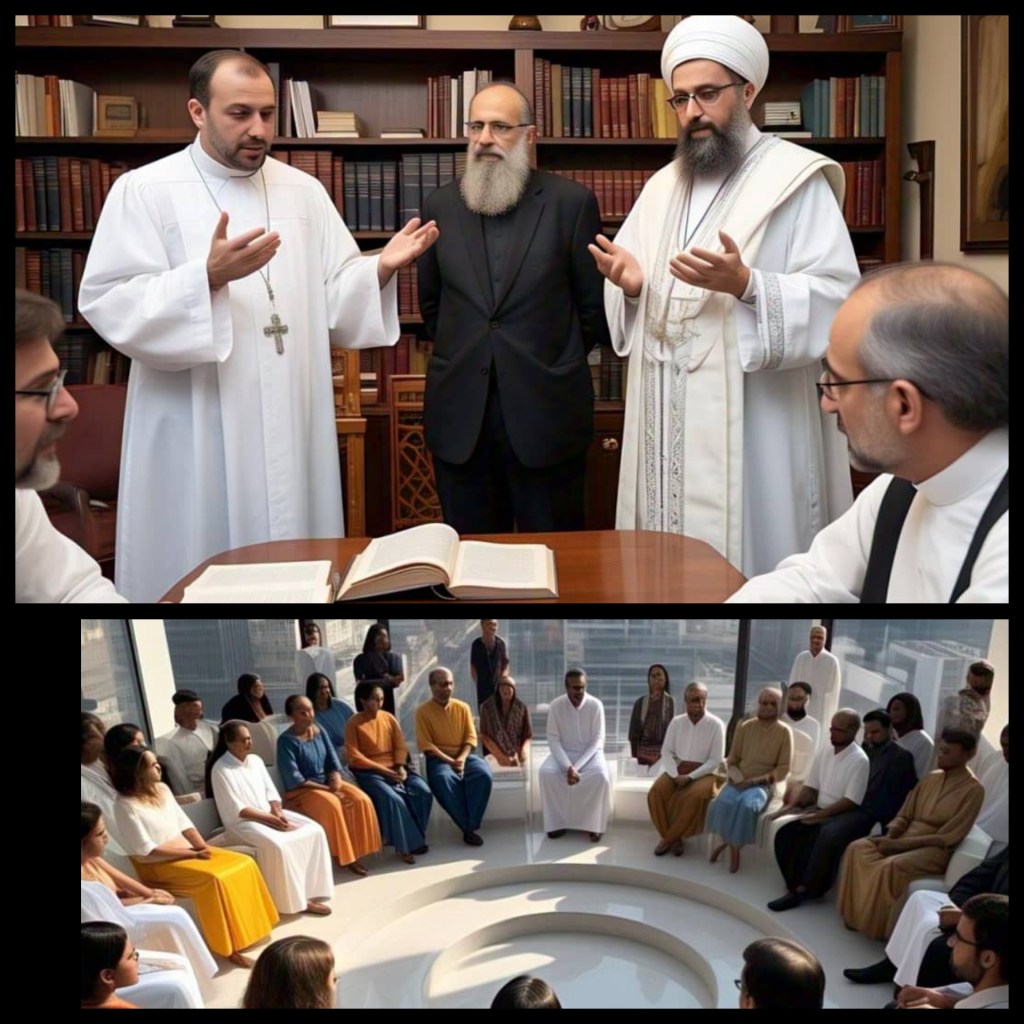
Set up monthly peace forums in mosques, churches, and universities where youth of different faiths can build bridges.
5. Hold the State Accountable:
Governments must arrest and prosecute hate preachers, regardless of faith. Silence emboldens the dangerous.
In conclusion, religion is not the enemy of the society. It is the mirror. It reflects the soul of the society that practices it. If that society is selfish, greedy, and violent , hence those who practice the religion will echo it.But if society returns to sincerity, humility, and compassion, then religion becomes its highest expression.
The Prophet Muhammad warned, “The worst of men are those who use religion to eat the world.” Jesus too scolded the Pharisees: “You clean the outside of the cup, but inside are greed and wickedness.”It’s time we clean the inside.
Let the pastor return to the pulpit—not the palace. Let the imam face the Qur’an—not the governor. Let the people rediscover faith—not fanaticism.
Only then will religion move from the rubble of destruction… to the architecture of construction, therefore , the problem of our society is not religion but you and I who belongs to one religion or the other.
 ..all about information services
Leave a Reply